
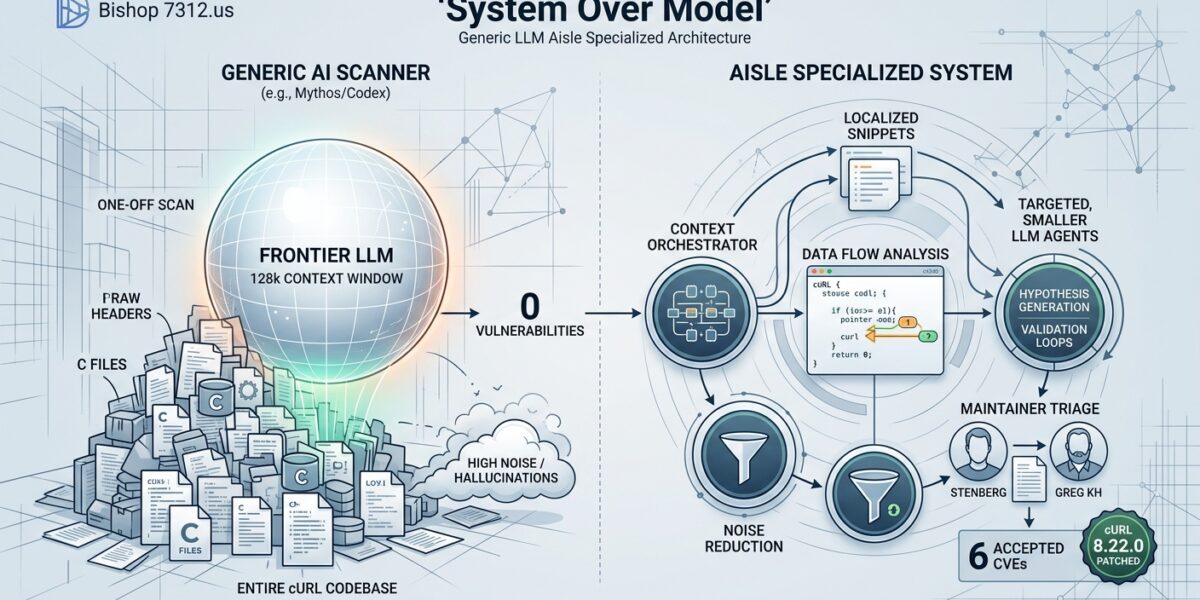
When OpenAI’s Codex, Anthropic’s Mythos, and ZeroPath all scanned cURL—one of the most heavily scrutinized, ubiquitous C codebases on Earth—they came back with zero new vulnerabilities.
Then Aisle, an AI-native vulnerability management startup, ran its system over the exact same codebase. Result? 29 candidate issues reported, 6 accepted low-severity CVEs patched in cURL 8.22.0, and nod of respect from open-source heavyweights like Daniel Stenberg (cURL creator) and Greg Kroah-Hartman (Linux kernel maintainer).
As Steven Vaughan-Nichols reported on ZDNet, even Greg KH remarked: “No idea what Aisle is doing differently, but wow…”
At 7312.us, we’ve been hammering on a core thesis for some time: A raw LLM is not a security tool; it’s an engine. The real innovation isn’t in buying bigger, more expensive frontier models. It’s in the harness you build around them.
Let’s break down why Aisle’s approach is a genuine shift in AI application security—and where its limits lie across C, Java, Python, and beyond.
1. The Core Innovation: “System Over Model”
The common failure mode for AI vulnerability scanners is simple: throw a 128k context window at a whole repository, ask “Find bugs,” and watch the model hallucinate 50 pages of noise or miss the forest for the trees.
Aisle explicitly rejects the frontier-model arms race. Their thesis: Even smaller, cheaper models can spot complex vulnerabilities if provided with tight, context-rich code snippets and rigorous agentic workflows.
Instead of relying on single-pass inference, Aisle’s architecture relies on systematic context orchestration:
- Local Context & Flow Analysis: Extracting precise execution paths, state transitions, and pointer lifetimes rather than dumping raw file dumps.
- Hypothesis & Verification Loops: Generating dynamic candidate hypotheses, executing reproduction tests, and filtering noise before a human maintainer ever sees a report.
- Maintainer-Centric Triage: Working with maintainers (like Stenberg) to tune signal-to-noise ratios. Aisle filed 29 reports to yield 6 CVEs (~20% conversion rate). In the world of AI-generated slop, a 20% actionable yield on a mature codebase is astonishingly high.
This isn’t a better foundation model—it’s better security architecture.
2. Does It Work Beyond C? (C vs. Java vs. Python)
cURL is written in C. C is notorious for memory corruption, buffer overflows, use-after-free, pointer arithmetic errors, and explicit manual state management.
How well will Aisle’s system paradigm translate across the polyglot stack?
┌────────────────────────────────────────────────────────────────────────┐
│                        AI Vulnerability Matrix                         │
├──────────────┬───────────────────────────────┬─────────────────────────┤
│ Language     │ Dominant Vulnerability Class  │ AI Analysis Difficulty  │
├──────────────┼───────────────────────────────┼─────────────────────────┤
│ C / C++      │ Memory safety, Pointer math   │ High (Local context)    │
│ Java / C#    │ Logic errors, Injection, Auth │ High (Global/Deep AST)  │
│ Python / JS  │ Dynamic typing, Supply chain  │ Medium (Runtime bounds) │
└──────────────┴───────────────────────────────┴─────────────────────────┤
Memory-Unsafe Languages (C / C++) — The Local Context Sweet Spot
C vulnerabilities are often spatially clustered. A missing check on a buffer size, an unsafe memcpy, or a bad pointer dereference can frequently be identified by analyzing a few dozen lines of code, provided you understand the data flow leading into that function. This is why small, context-focused LLMs excel here when guided properly.
Managed Runtimes (Java, C#) — The Global Context Challenge
Java rarely suffers from traditional buffer overflows. Instead, enterprise Java security bugs live in complex abstraction layers:
- Object deserialization flaws (
readObjectgadgets) - Broken Role-Based Access Controls (RBAC) across multi-tiered Spring microservices
- Blind SQL injection through dynamic ORM mapping
- Indirect SSRF via complex factory patterns
Finding these requires understanding how data propagates across dozens of files, interfaces, and dependency injected components. If Aisle’s context engine can trace dependency graphs across giant enterprise frameworks as effectively as it tracks pointers in C, it will do well. If it relies primarily on localized file-level snippets, it will miss deep architectural bugs in Java.
Dynamic Languages (Python, JavaScript/TypeScript) — The Dynamic Runtime Trap
Python bugs often hinge on dynamic execution and implicit behaviors:
- Unsanitized
eval()/exec()calls or dangerous YAML loading - Prototype pollution and loose equality quirks (JavaScript)
- Type confusion resulting from dynamic duck-typing
Because Python lacks explicit type definitions and static compilation checks, static analysis (and LLMs relying on code structure) frequently struggles with dynamic path execution. Aisle’s hypothesis-and-reproduction loop will need to incorporate active dynamic execution (fuzzing/sandboxed runtime execution) to avoid high false-positive rates in Python ecosystems.
The Takeaway
Aisle’s performance on cURL is a watershed moment for AI application security. It proves that agentic orchestration and contextual preprocessing trumps raw parameter count.
Will it find bugs as effectively in Java and Python?
- For localized logic flaws and pattern-based vulnerabilities: Absolutely.
- For architectural logic flaws, deep object deserialization, and runtime-dependent execution paths: Aisle will need to expand its “system” from intelligent static context slicing to deep dynamic analysis and taint-tracking frameworks.
The era of “throw the repo into Claude/GPT-4 and pray” is over. The era of specialized, agentic security pipelines has arrived.