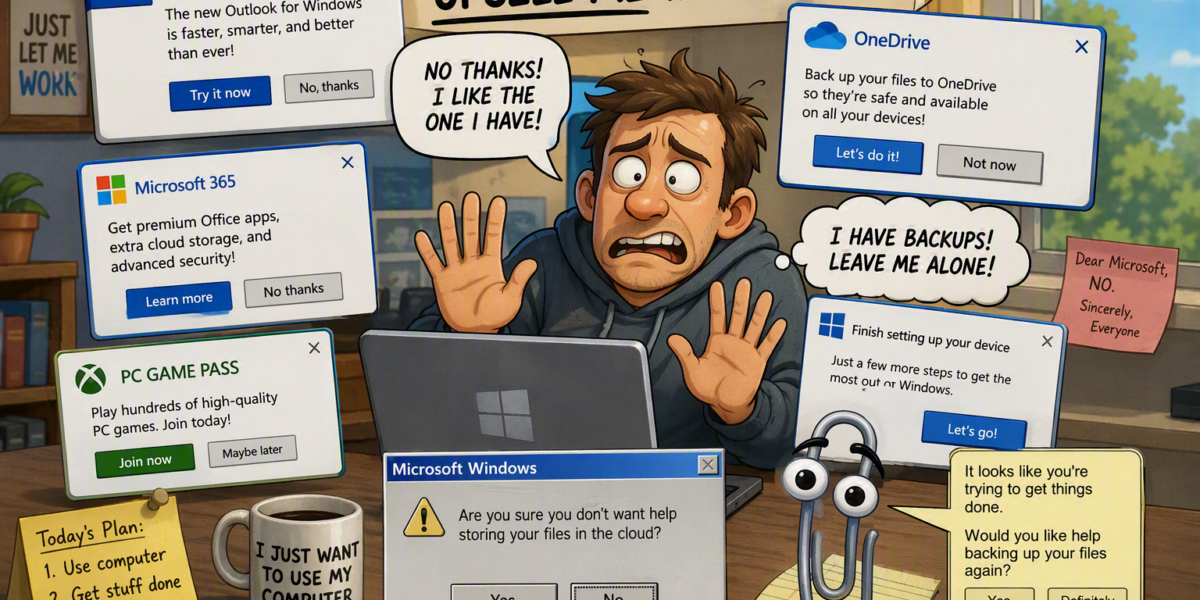

We asked Sonny (Microsoft Copilot): “Write a funny article : “I don’t want to try the new Microsoft Outlook! I don’t want to backup my files onto OneDrive! Stop trying to upsell me in Windows!” “
An opinion piece from a perfectly calm, completely reasonable Windows user who is definitely not clicking “Remind me later” for the 847th time.
There comes a moment in every Windows user’s life when they sit down at their computer, ready to perform a simple task, only to discover that Windows has other plans.
You open your laptop to pay a bill.
Windows wants to talk about OneDrive.
You launch Outlook to check an email.
Microsoft wants to talk about New Outlook.
You accidentally breathe near the Start menu.
Somewhere deep inside Redmond, a marketing algorithm whispers:
“This individual appears insufficiently enthusiastic.”
The New Outlook Experience
Nothing strikes fear into the heart quite like a button labeled “Try the New Outlook.”
Microsoft presents this option with the confidence of a waiter insisting you’ll absolutely love the squid special.
“No thanks,” you say.
A week later, the button returns.
“No thanks.”
Another week passes.
The button has now moved slightly. It’s learned.
Eventually, you begin to feel like you’re trapped in a time loop.
Windows: Try the New Outlook.
You: No.
Windows: Are you sure?
You: Yes.
Windows: But what if it has rounded corners?
You: I SAID NO.
The odd thing is that many users don’t even dislike the new Outlook. They’re just perfectly happy with the current one. Yet Microsoft’s enthusiasm resembles that friend who discovers a new diet and suddenly becomes an unpaid evangelist.
“Have you tried New Outlook?”
“No.”
“But it syncs things!”
“So did the old one.”
“But this one is new.”
“That’s not automatically an advantage.”
The OneDrive Negotiations
Then there’s OneDrive.
OneDrive isn’t a service anymore. It’s a lifestyle.
You create a file.
OneDrive appears.
You save a file.
OneDrive appears.
You accidentally think about files.
OneDrive appears from behind a curtain.
“Hello. I noticed you’re storing things.”
The relationship feels less like software and more like an intervention.
“Have you considered backing up your files?”
“I have backups.”
“But do you have cloud backups?”
“Yes.”
“But are they our cloud backups?”
At some point, many users become convinced that if they leave their computer unattended long enough, Windows will quietly upload their grocery list, seventh-grade poetry, and a JPEG named definitely-final-v27-actual-final.jpg.
The Setup Screen Gauntlet
Buying a new PC has become a journey.
You just want to reach the desktop.
Instead, you embark on a guided tour.
“Would you like Microsoft 365?”
“No.”
“What about PC Game Pass?”
“No.”
“Would you like to finish setting up your device?”
“I thought that’s what I’ve been doing for the last twenty minutes.”
“How about OneDrive?”
“We’ve discussed this.”
“Let’s circle back.”
Every Notification Is a Sales Meeting
In older versions of Windows, notifications were simple.
“You have mail.”
Done.
Modern notifications sometimes feel like an eager sales representative trapped in your taskbar.
“Did you know you could get more from your Microsoft account?”
“Probably.”
“Would you like to explore premium features?”
“No.”
“We noticed you declined.”
“Correct.”
“We’ve prepared a PowerPoint presentation.”
The operating system increasingly behaves like somebody who mistakes politeness for interest.
The User’s Greatest Weapon
Microsoft believes persistence is the key to customer adoption.
Users believe persistence is clicking X repeatedly until retirement.
The battle has raged for years.
Microsoft adds a prompt.
Users dismiss it.
Microsoft redesigns the prompt.
Users dismiss it faster.
Microsoft adds colorful graphics.
Users develop muscle memory.
Entire generations of Windows users have achieved Olympic-level reflexes when locating “Not now.”
A Modest Proposal
Perhaps Windows should introduce a new feature.
A giant button labeled:
“I Know What I’m Doing.”
When pressed, it would disable all upgrade suggestions, promotional banners, setup reminders, and friendly nudges.
Windows would simply nod respectfully and say:
“Understood. You are here to use a computer. We shall not speak of OneDrive again unless you bring it up first.”
The desktop would fall silent.
The clouds would part.
A choir would sing.
And somewhere, deep within Microsoft’s headquarters, a lonely notification would fade away, whispering its final words:
“But… the new Outlook has rounded corners…”