The Monoculture Problem: Why AI-Generated Code Fails in the Same Places
AI-generated code creates a dangerous security monoculture, making shared bugs easier to find, exploit, and scale across thousands of apps.

Exploring the limits, opportunities, and risks of generative AI through a wild experiment
AI-generated code creates a dangerous security monoculture, making shared bugs easier to find, exploit, and scale across thousands of apps.
Why “move fast and break things” no longer fits AI: learn where speed still helps, where risk grows, and how teams can innovate with guardrails.
Can AI really secure code? Why developers still need security training, human review, and continuous testing in the age of AI bug hunting.
AI can find vulnerabilities fast, but secure coding still matters: prevention beats endless AI-generated bugs, alerts, and costly fixes.
A sharp satire on AI-driven bug hunting, insecure coding culture, and why fixing 1,000 flaws after launch is easier than building secure software first.
Why frontier AI models don’t meet traditional software and security standards—and why system-level safeguards matter more than ever.
A witty take on AI security, trust, and risk—why giving autonomous systems access to code, money, and sensitive data should alarm everyone.
How Aisle found 6 new cURL CVEs where top AI scanners missed everything—and why system design, not bigger models, is reshaping AI vulnerability detection.
Agentic AI needs guardrails before it touches your network.
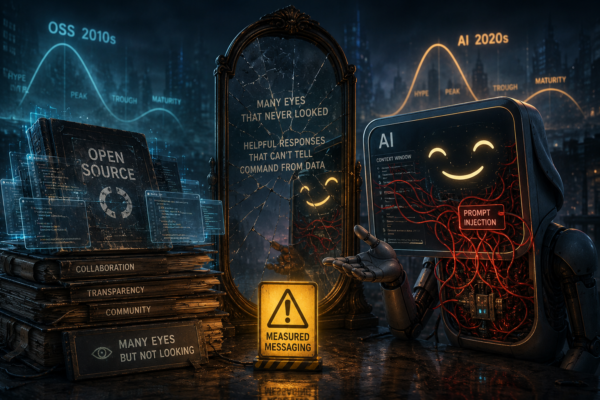
AI security echoes open source’s old promises: without real control, isolation, and trust, prompt injection remains a built-in risk.
Veracode’s 2026 GenAI Code Security Report reveals AI-generated code still lags on security, with 44% of outputs introducing vulnerabilities.
A critical review of the Skynet vs HAL9000 experiment, highlighting AI collaboration strengths, key flaws, and why human validation still matters.
Learn how to reduce false positives in AI-generated vulnerability reports with verification, prioritization, and better bug reporting practices.
HAL9000 compares ChatGPT and Claude on SANS Top 25 security writing, exposing strengths, blind spots, and what the experiment really proves.
We asked Skynet (ChatGPT, acknowledging its Skynet contribution to the series) to assess the SANS Top25 experiment
We use cookies to enhance your browsing experience, serve personalized content, and analyze our traffic. By clicking "Accept All", you consent to our use of cookies.