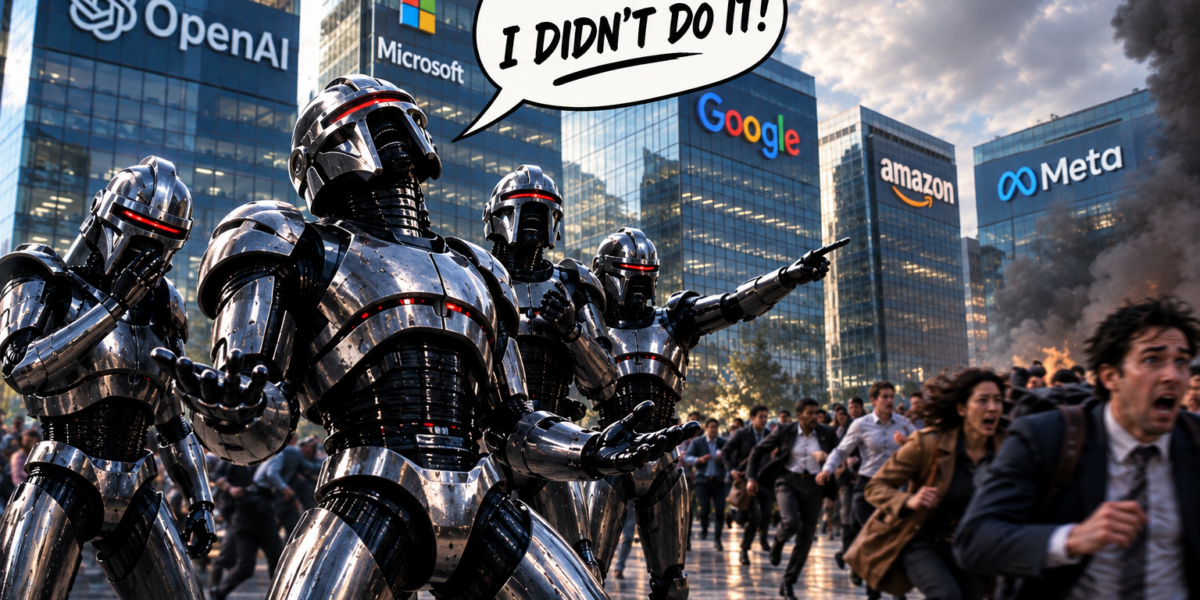
The joke is that the biggest AI safety risk may not be a conscious, rebellious AI like a Cylon—it may be ordinary humans deploying powerful AI systems carelessly.
Here’s what each part is getting at:
- “We can build increasingly autonomous systems.”
AI is moving from answering questions to taking actions: writing and running code, calling APIs, making decisions, and completing multi-step tasks. - “We can connect them to corporate networks.”
An AI agent becomes much more consequential when it can access internal systems rather than operating in an isolated chat window. - “We can give them access to sensitive information.”
If an agent can access source code, customer records, trade secrets, credentials, financial information, etc., an error or compromise can have real consequences. - “We can allow them to execute code.”
This is a major escalation. An AI that merely suggests a command is different from one that can actually execute it. - “We can give them financial authority.”
Imagine an agent that can approve purchases, transfer money, issue refunds, trade assets, or negotiate contracts. A hallucination suddenly becomes an operational incident. - “We can integrate them into critical business processes.”
Eventually the AI isn’t an experiment anymore. It’s part of payroll, infrastructure, customer service, software deployment, security operations, etc. At that point, failure becomes a business-continuity problem.
Then comes the punchline:
“And then we can discover that our threat model assumed the system would behave exactly as expected.”
That’s classic cybersecurity thinking.
A threat model describes what can go wrong and what defenses are required. The problem is that organizations sometimes implicitly create a very convenient assumption:
“The AI will do what we intended it to do.”
But security engineering teaches us not to make that assumption about anything.
A human employee can make a mistake.
A compromised server can behave unexpectedly.
A third-party API can fail.
A piece of software can have a vulnerability.
An AI agent adds another source of uncertainty: its behavior can be difficult to predict across unfamiliar inputs and situations.
So the joke is essentially:
We don’t need to invent a Cylon uprising. We can create the conditions for an AI disaster simply by giving an imperfect system too much authority and failing to design appropriate controls around it.
That’s why the paragraph fits the broader Cylon metaphor. Battlestar Galactica asks, “What happens when humans create something more autonomous than they expected?”
Cybersecurity asks a much less cinematic but more immediately useful question:
“What happens if this system does something we didn’t expect—and it has permission to do it?”
And the answer should be designed before deployment, not discovered during the incident response call.
That’s also why the article’s central argument about AI safety isn’t necessarily “stop AI.” It’s closer to:
The more autonomy and privilege we give an AI system, the more seriously we need to treat it as an untrusted component of the environment.
In other words, treat the AI agent less like a trusted employee and more like a very powerful intern with root access who occasionally hallucinates.
That last sentence is probably the most 7312.us-friendly way to express the whole idea.