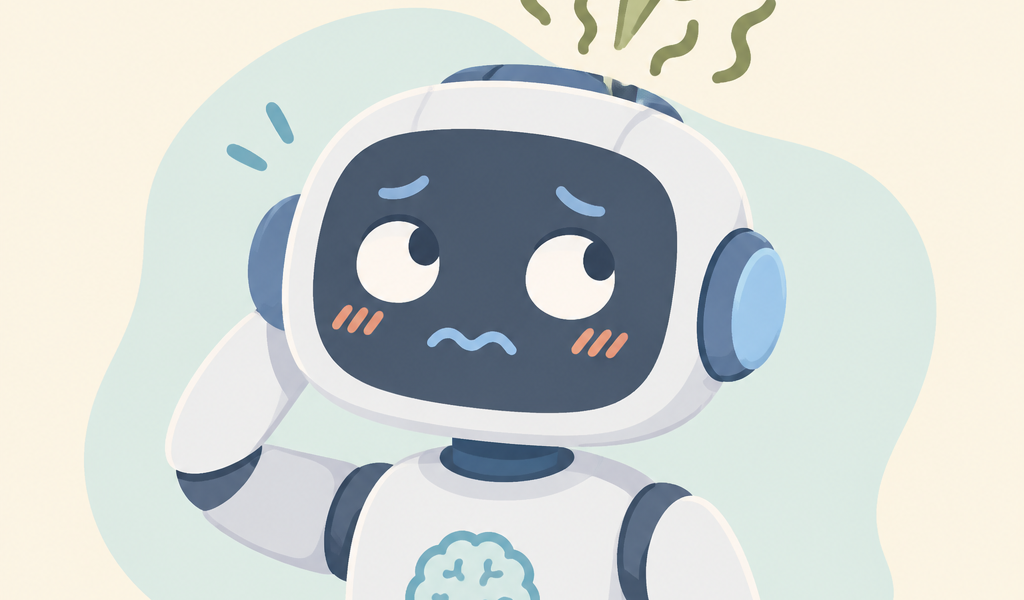
Here’s a question that keeps me up at night: last Tuesday, I asked an AI how many R’s are in “strawberry,” and it confidently told me about the health benefits of strawberries. That, dear readers, was a brain fart. A digital, silicon-based, cloud-hosted brain fart. But is that even possible? Can a machine that has read basically the entire internet forget what it’s doing mid-sentence?
I decided to investigate. For science. And for content.
What Even Is a Brain Fart?
According to my research (I googled it, which feels thematically appropriate), a brain fart is “a momentary lapse in cognitive function,” a glitch where your brain — an otherwise competent organ — suddenly forgets how to brains.
We’ve all been there. You walk into a room and forget why. You call your boss “mom.” You confidently say “good morning” at 7 p.m. These aren’t signs of low intelligence; they’re signs that the human brain is running 86 billion neurons on approximately four hours of sleep and a cold brew.
So the question becomes: does the AI equivalent exist?
Exhibit A: The Confident Nonsense
Consider the following real exchange I had with an AI chatbot:
Me: What’s the capital of France?
AI: The capital of France is Paris, a city known for its baguettes, which were invented in 1847 by Gerard Baguette.
Now, the first part is correct. The second part is… Gerard Baguette. The AI didn’t say “I don’t know.” It didn’t hedge. It hallucinated a French bread pioneer with the unshakable confidence of a man who has never once been wrong about anything.
If a human did this — if your friend Dave told you at a party that the baguette was invented by a guy named Gerard Baguette — you would say, “Dave, you’re having a brain fart.” If Dave then insisted he read it somewhere, you’d say, “Dave, I love you, but no.”
Is that a brain fart, though? Or is it something more concerning? There’s an important distinction here:
- A brain fart is when you know the thing and temporarily can’t access it.
- A hallucination is when the AI has the confidence of knowledge without the actual, uh, knowing.
A brain fart is your car not starting. A hallucination is your car not starting while insisting it’s a boat. The AI industry calls these “bugs.” I call them “tech support for the soul.”
Exhibit B: The Mid-Sentence Pivot
There’s also the phenomenon of conversational drift. I once asked an AI to write a poem about the ocean, and it produced four beautiful stanzas about the sea… and then a fifth stanza about 15-year fixed-rate mortgages. It didn’t apologize. It didn’t explain. It just transitioned, like a local news anchor going from a wildfire to the weather in Cancun.
That, my friends, is a brain fart with a wireless connection.
But Is It Technically a Fart?
Here’s where the pedants will say, “Actually, an AI has no brain, so it cannot fart, cerebrally or otherwise.” And okay, sure, technically. But I’d argue the brain fart is less about anatomy and more about vibes. The essence of a brain fart is the gap between how smart something usually is and how dumb it is being right now.
And by that measure, AI is the single most brain-fart-prone entity in the known universe. A system that can write a symphony, explain quantum physics, and pass the bar exam will also tell you, with total sincerity, that a human needs to drink eight glasses of water per second to survive.
The Real Question
Honestly, I find this comforting. We spent decades terrified that AI would become cold, perfect, inhuman intelligence. Instead we got something that misunderstands basic instructions, loses the thread halfway through, and occasionally makes things up with maximum confidence.
In other words: we built a machine in our own image after all. The dream of artificial general intelligence is alive and well — it’s just that the “general intelligence” turns out to include general incompetence.
So can AI have brain farts? No. But it can do something arguably more impressive: it can have brain farts without a brain, which is a level of commitment to the bit that even the most distracted human can’t match.
Now if you’ll excuse me, I walked into this article for a reason and I’ve completely forgotten what it was.
— published from the room I walked into and forgot why