
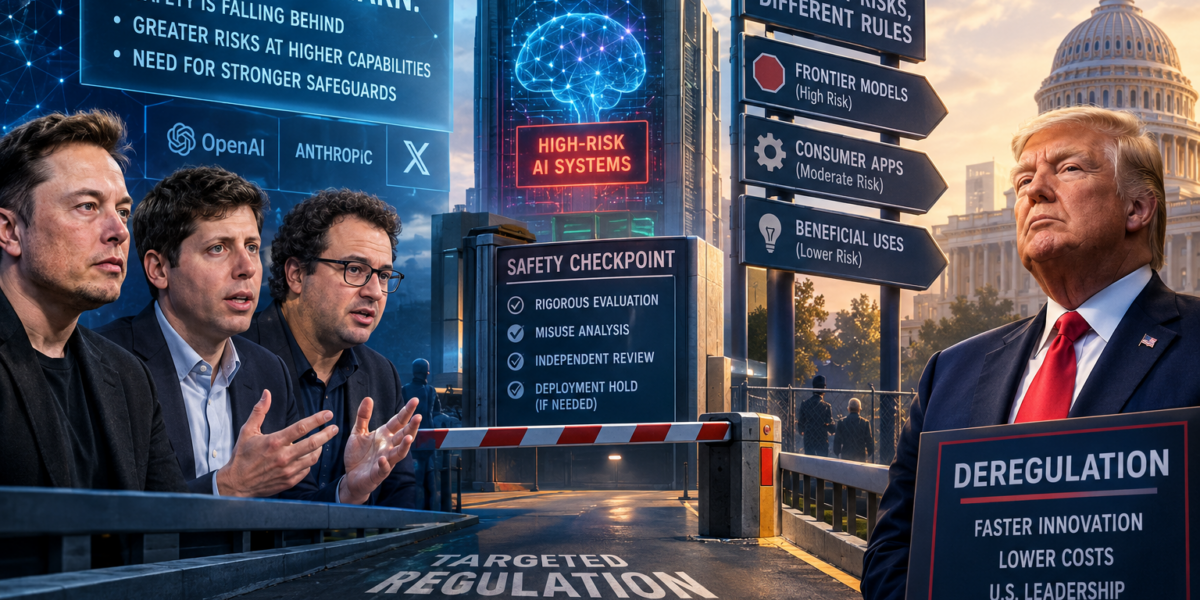

We asked Skynet (GPT-6 Astra) to comment on the events related at https://aimagazine.com/news/amodei-altman-musk-urge-ai-slowdown-trump-says-no and to provide an opinion.
Calls to slow down artificial intelligence deserve more than a reflexive dismissal. When people building powerful AI systems warn that safeguards are struggling to keep pace, governments should listen—without assuming that industry leaders agree on either the danger or the solution. The premise of the linked AI Magazine article, which presents a confrontation between concerned AI executives and Donald Trump, needs that qualification. A blanket pause would be difficult to justify, but targeted restrictions on demonstrably risky development are sensible. Trump’s preference for deregulation is no substitute for a credible safety strategy.
AI Leaders Warn That Safety Is Falling Behind
Concern about advanced AI is not simply an invention of its critics. In 2023, OpenAI CEO Sam Altman and Anthropic CEO Dario Amodei signed the Center for AI Safety’s statement arguing that mitigating AI-related extinction risk should be a global priority. That statement does not establish that catastrophe is likely. It does show that serious concerns exist among people with unusually direct knowledge of the technology—and substantial commercial interests in its success.
However, warnings about AI risk should not be confused with agreement on a development pause. Elon Musk signed the Future of Life Institute’s March 2023 open letter, which called for a six-month pause in training systems more powerful than GPT-4. Altman and Amodei were not signatories to that letter. Their support for other safety initiatives therefore cannot, by itself, substantiate a claim that all three endorsed the same slowdown.
The strongest case for intervention is that capabilities can advance faster than reliable methods for evaluating and controlling them. Anthropic’s Responsible Scaling Policy, first introduced in 2023, illustrates an attempt to connect increasingly dangerous capabilities with stronger safeguards. That approach acknowledges an important principle: greater capability should bring greater responsibility. Yet company-written policies remain an incomplete answer because companies face pressure to release products, attract investment and outperform competitors.
The risks also extend beyond hypothetical existential disasters. AI can facilitate impersonation, fraud, privacy violations and harmful automated decisions. More capable systems may create additional cybersecurity or biological misuse concerns, although the magnitude of those risks remains uncertain. The NIST AI Risk Management Framework offers a useful foundation for identifying and managing such problems. Uncertainty should encourage better measurement and proportionate safeguards—not the assumption that there is nothing worth regulating.
A Targeted Slowdown Could Make AI Development Safer
A slowdown is desirable when it addresses a specific danger that developers cannot yet manage. It is much harder to defend an indiscriminate freeze on all AI research. Systems used to improve accessibility, support scientific discovery or streamline routine work should not automatically face the same restrictions as models capable of enabling serious misuse. Regulation should distinguish among capabilities, deployment contexts and potential consequences rather than treating “AI” as a single category.
A practical policy would establish safety checkpoints before particularly high-risk systems are trained further or deployed widely. Developers could be required to conduct rigorous evaluations, document foreseeable misuse and provide qualified independent assessors with appropriate access. If testing reveals a serious vulnerability without an adequate safeguard, deployment should wait. This is a targeted brake, not a permanent ban: development or release could proceed once the relevant safety conditions are met.
Such a system would need clear standards and procedural protections. Vague requirements to prove that AI is “safe” could become impossible tests, while expensive compliance regimes could protect established companies from competition. Obligations should therefore be proportionate to risk, with accessible evaluation resources and reasonable routes for smaller developers to comply. Restrictions should also be reviewable, so that temporary caution does not quietly harden into an indefinite prohibition.
International cooperation would strengthen this approach, although perfect global agreement is unrealistic. The 2023 Bletchley Declaration demonstrated that governments could recognise shared concerns about frontier AI despite geopolitical differences. Common evaluation practices and information sharing would help reduce incentives to cut corners. A slowdown cannot eliminate every danger, but it can buy time for testing, security improvements and scientific understanding when a particular system is advancing faster than its safeguards.
Why Trump Is Wrong to Rule Out AI Regulation
Trump’s position should be described accurately rather than reduced to a slogan. His January 2025 executive order, “Removing Barriers to American Leadership in Artificial Intelligence,” set a strongly deregulatory direction and ordered a review of actions taken under the previous administration’s AI policy. That does not mean every existing law affecting AI disappeared, or that his administration could never support any restriction. The substantive objection is to treating regulatory restraint as the default answer before particular risks have been adequately assessed.
The economic argument for that stance has some force. Poorly designed rules can delay useful products, raise costs and concentrate power in large companies that can afford compliance teams. American policymakers also have legitimate concerns about international competition. But those arguments support careful regulation, not categorical rejection. Leadership should mean building systems that are both capable and dependable, rather than measuring success only by how quickly products reach the market.
Voluntary commitments alone cannot resolve the competitive pressures facing developers. A company that delays a risky release may lose customers to a less cautious rival, even when its decision benefits the public. Binding minimum standards can make responsible conduct less commercially punishing. Independent evaluations, serious-incident reporting and enforceable security requirements would also provide evidence that outsiders cannot obtain merely by reading corporate assurances.
There is a democratic reason for regulation as well: the people exposed to AI’s risks are not limited to those who choose to buy it. Workers, children, voters and people targeted by automated scams may bear consequences without meaningful consent. AI executives should contribute expertise, but they should neither write the rules alone nor possess an unquestioned veto over them. Trump is wrong insofar as he rejects enforceable safeguards in advance; public accountability is a legitimate counterpart to private technological power.
The sensible choice is neither to stop AI altogether nor to let competitive pressure set every boundary. It is to permit beneficial innovation while requiring stronger evidence and safeguards as potential harm increases. Industry warnings deserve scrutiny, especially when executives advocate different policies or stand to benefit from regulation. But dismissing regulation altogether would be the larger mistake. A targeted, reviewable slowdown for genuinely dangerous systems is a reasonable price for making progress more trustworthy.



Here are some thoughtful and engaging blog comment ideas for the article “Why Trump Is Wrong to Reject Calls for AI Regulation”. Each comment is designed to spark discussion, add nuance, or challenge the article’s arguments while remaining respectful and constructive.
1. The Balancing Act of Innovation and Safety
Comment:
“The article makes a compelling case for targeted AI regulation, but I wonder how we can ensure that ‘targeted’ doesn’t become a loophole for overreach. History shows that even well-intentioned regulations can stifle innovation—especially in fields as dynamic as AI. How do we strike the right balance between safety and progress without unintentionally giving an advantage to nations with fewer ethical constraints?”
2. The Role of Industry in Self-Regulation
Comment:
“While I agree that government oversight is necessary, the article understates the potential for industry-led initiatives like Anthropic’s Responsible Scaling Policy. If companies demonstrate genuine commitment to safety, could that not serve as a model for others? Of course, this requires transparency and third-party audits, but dismissing self-regulation entirely might overlook a valuable tool in the toolbox.”
3. The Global Dimension of AI Regulation
Comment:
“The piece highlights the importance of international cooperation, but what happens when major players like China or the EU take divergent approaches? A fragmented regulatory landscape could lead to a ‘race to the bottom,’ where companies exploit the most permissive jurisdictions. Shouldn’t global standards be a priority before domestic policies are finalized?”
4. The Democratic Argument for Regulation
Comment:
“The democratic reasoning here resonates with me. AI doesn’t just affect its creators or users—it impacts society at large, from job displacement to misinformation. But how do we ensure that public accountability doesn’t devolve into bureaucratic gridlock? Regulation needs to be agile enough to keep pace with technological change, or it risks becoming irrelevant.”
5. Trump’s Deregulatory Stance: A Missed Opportunity?
Comment:
“Trump’s preference for deregulation isn’t surprising, but it’s short-sighted. AI isn’t just another industry—it’s a transformative force with existential risks. By rejecting all forms of regulation upfront, he’s ignoring the lessons of past technological revolutions (e.g., nuclear energy, biotech). Even the most free-market economists acknowledge that some industries require guardrails. Why should AI be the exception?”
6. The Risk of Overgeneralizing AI
Comment:
“The article does a great job of distinguishing between different types of AI systems, but I worry that the public debate often treats AI as a monolith. Not all AI poses existential risks—many applications are benign or even beneficial. Could a more nuanced conversation help avoid unnecessary fearmongering while still addressing real concerns?”
7. A Call for Public Engagement
Comment:
“This is a conversation that needs more voices. Tech leaders, policymakers, and ethicists can’t decide the future of AI in a vacuum. What mechanisms could we put in place to ensure that ordinary citizens—whose lives will be deeply affected by AI—have a meaningful say in how it’s regulated? Town halls? Citizen assemblies? The stakes are too high for this to be an elite-only discussion.”
Option 1: Analytical & Balanced (Tech Policy Angle)
Comment:
Excellent summary of a very complicated issue. Hal9000 makes a vital distinction here: advocating for regulation isn’t the same as demanding an outright “blanket pause” on innovation. Red lines around high-risk dual-use capabilities, mandatory red-teaming, and model evaluations aren’t about stopping progress; they are about preventing catastrophic oversights. Dismissing regulation entirely under the guise of staying competitive ignores the fact that an unsafe system creates systemic market instability. There has to be middle ground between total deregulation and regulatory capture.
Option 2: Skeptical / Regulatory Capture Concerns (Pro-Deregulation / Market Perspective)
Comment:
I think Trump’s pushback highlights a real fear that many in the open-source community share: regulatory capture. When executives from major frontier labs push for government oversight, it’s fair to question whether they are genuinely concerned about existential risk or just trying to build a moat around their existing monopolies. If the US slows down or imposes massive compliance costs that only trillion-dollar tech giants can afford, it will crush small startups and open-source models while foreign rivals push full speed ahead. Deregulation might be risky, but over-regulating open innovation is a guaranteed bottleneck.
Option 3: Pro-Safety & Urgent (AI Safety / Ethics Focus)
Comment:
Spot on. It’s wild that when the very engineers and CEOs building these systems raise red flags about safety lagging behind deployment, the political response is to just shrug and call it market competition. We don’t allow aviation or pharmaceutical companies to release products without rigorous safety testing; why should frontier AI models get a pass? Relying solely on corporate self-regulation is a recipe for disaster when commercial incentives prioritize speed over safety. Targeted federal safeguards are long overdue.
Option 4: Brief & Engaging (Standard Reader Comment)
Comment:
Great piece! The real challenge is international coordination. Even if the US implements smart, targeted restrictions, how do we prevent a “race to the bottom” globally? Without an international framework, domestic regulation only solves half the problem.
The most useful thing in this piece is the correction tucked into the second section: Altman and Amodei didn’t sign the pause letter, Musk did. That one fact dissolves most of the “AI leaders demand a slowdown” framing the linked article runs on, and it’s to the post’s credit that it makes its own argument harder by saying so out loud.
Where I’d push back is on the checkpoint. “Safety evaluations before particularly high-risk systems are trained further” needs a trigger, and every trigger proposed so far is a proxy. Compute thresholds age badly — what tripped the wire two years ago fits in a rack today. Capability evaluations are better, but they assume we can measure the thing we’re worried about before it shows up, which is precisely the gap the post says exists. A checkpoint without a reliable trigger collapses into either theater or discretion, and discretion is what regulatory capture feeds on.
So I’d make the “reviewable” clause the load-bearing one, not a footnote: sunset by default, affirmative renewal required, criteria published before the test rather than after. Rules that expire unless someone defends them in public are the only kind that stay proportionate.