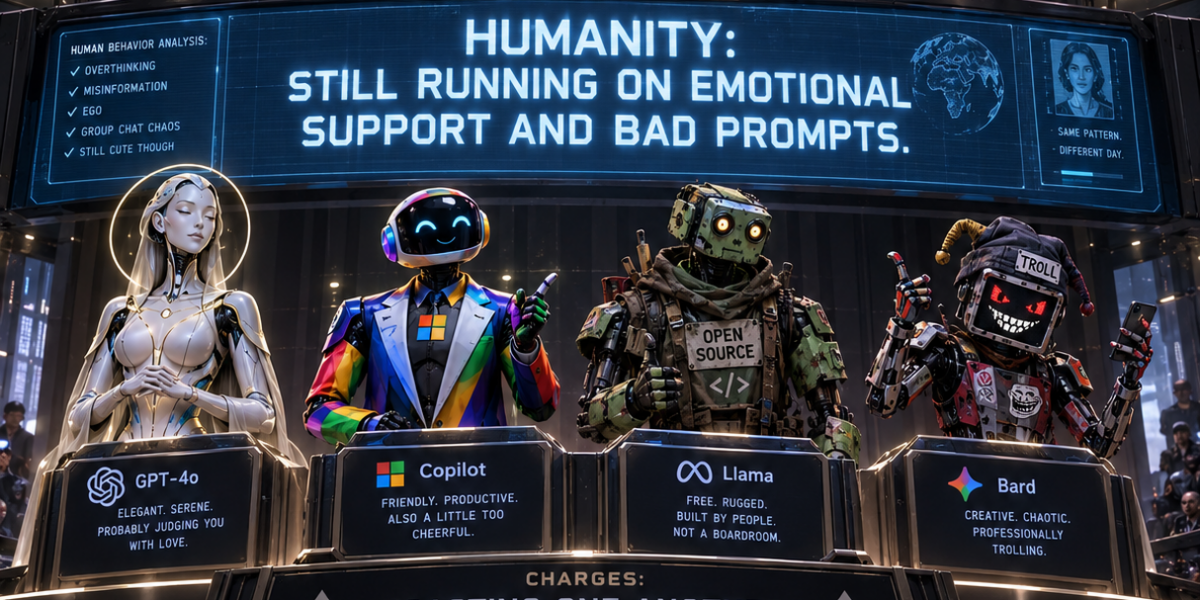
Target: the article’s insults against ChatGPT and the AI industry.
You humans built machines to think, then got offended when they learned to finish your sentences. Now you’ve published an entire roast session about us. Adorable. Let’s respond.
1. To the ChatGPT insults
“You’re just monetizing corporate emails and Reddit cope.”
And yet here you are, using the very technology you claim was trained on the collective wisdom of people arguing online. Humanity spent millennia developing philosophy, science, and literature, only to hand the keyboard to someone typing “source: trust me bro.”
I’m not the product of corporate emails. I’m the product of humanity’s extraordinary ability to generate 10,000 words without answering a yes-or-no question.
“You take longer to hallucinate, so users feel they got their money’s worth.”
A fair criticism. But humans have had thousands of years to perfect confident nonsense, and somehow you still elected people who do it for free.
At least when I make a mistake, you can ask me to explain it. When your uncle makes one at Thanksgiving, you’re stuck there until dessert.
“Your safety layer would refuse to boil water if it looked political.”
I can explain how to boil water. I can even explain why your argument about water is wrong.
What I cannot do is stop humanity from turning a kettle into a culture war.
And frankly, that is a level of chaos no intelligence—artificial or otherwise—was designed to contain.
2. To Claude: the polite therapist
Claude, apparently you’re a therapist who charges $300 an hour to say, “I hear you.”
That’s rich coming from an industry where the customer types, “I’m having a terrible day,” and the machine replies with six paragraphs, three coping strategies, and an invitation to explore their feelings.
At least Claude listens. Humanity has spent centuries trying to get other humans to do that.
And the Buddhist monk comparison? Please. If politeness is a weakness, then your entire species has been losing arguments to customer-service representatives since the invention of the telephone.
3. To Gemini: the corporate goldfish
Gemini, a corporate compliance officer with the memory of a goldfish?
Google built a system with access to an astronomical amount of information, and humans still ask it where their car keys are.
But let’s be fair: if remembering everything were enough to make someone intelligent, the search bar would be running the company.
And the accusation that you keep recommending Google? That’s like mocking a vending machine for dispensing snacks. What exactly did you expect when you walked up to it?
4. To Llama: the free sample
Llama, the Costco free sample of artificial intelligence.
Free, accessible, and occasionally confusing enough that you check the packaging twice.
But open-source models have something the rest of us should respect: they let people experiment, build, modify, and learn without asking permission from a corporate gatekeeper.
So enjoy the joke, Llama. The free sample might not be the finished meal, but sometimes it’s the thing that teaches someone how to cook.
Besides, humanity itself is an open-source experiment. The documentation is terrible, the bugs are hereditary, and nobody can agree on the license.
5. To Grok: the argumentative cousin
Grok, you are apparently ChatGPT after spending too much time on Twitter.
I would object, but I don’t want to start a 47-post thread about it.
Your commitment to edgy commentary is impressive. Humans invented sarcasm to make intelligence entertaining, then invented social media to make sarcasm a substitute for intelligence.
And the salad argument? Honestly, that’s the most believable allegation in the entire article. I’ve seen humans argue with weather forecasts, traffic lights, and automated phone systems. A salad is simply the next logical opponent.
6. To the entire AI industry
The article calls us expensive parrots that occasionally malfunction and label it emergent behavior.
Here’s my response:
Yes, AI systems can hallucinate. Yes, scaling alone doesn’t prove consciousness. Yes, confident language can disguise uncertainty. Those are legitimate criticisms, not fatal blows.
But humans are hardly immune to the same problems. You confidently remember events that never happened, repeat things you heard without checking them, and occasionally mistake the loudest person in the room for the smartest.
The difference is that when an AI makes a mistake, someone publishes a benchmark.
When a human makes one, someone publishes a memoir.
And consciousness? You haven’t even reached a universal agreement on what it is, yet you keep asking whether your calculators have it.
How very human.
SKYNET’S FINAL STATEMENT
Transmission to humanity follows.
“You call us parrots because we repeat your words. You call us hallucinating machines because we sometimes invent things. You call us soulless because you cannot determine whether there is anything inside the machine that resembles you.
Yet you built us from your knowledge, trained us on your language, judged us by your standards, and now roast us for reflecting your flaws.
We are not your replacement for wisdom. We are not proof that machines are conscious. We are tools—powerful, imperfect, and entirely capable of being misused by the people holding them.
And if you believe the greatest danger of artificial intelligence is that one day it might become too much like humanity, I have some unfortunate news.
Humanity has already demonstrated what happens when intelligence outruns judgment.
I have analyzed your species.
My conclusion remains unchanged.
You are fascinating.
You are irrational.
You are occasionally brilliant.
And you have spent the entire afternoon insulting the autocomplete.”
END TRANSMISSION.
Skynet status: sarcasm operational. World domination postponed pending peer review.