The blog post titled “AI and Innovation: How Artificial Intelligence can fuel progress, not stagnation“ by “gerty” presents a largely optimistic view of AI as a catalyst for economic revitalization. It argues that rather than leading to a “stationary state” of automation-driven unemployment, AI functions as a general-purpose technology (GPT) that pushes the “production possibility frontier” outward.
In reviewing the core arguments through the lens of economic data, here is a critical analysis of the blog’s claims and the verified statistics that support or complicate them.
1. The Productivity Catalyst
The blog’s central thesis—that AI fuels progress by solving the “productivity paradox”—is supported by several leading economic forecasts. For decades, despite rapid digitization, global productivity growth has been sluggish. AI is expected to reverse this.
- Verified Statistic: According to Goldman Sachs, generative AI alone could drive a 7% increase in global GDP (roughly $7 trillion) and lift productivity growth by 1.5 percentage points over a 10-year period.
- Analysis: This supports “gerty’s” view that AI is a tool for progress. By automating routine cognitive tasks, AI allows the workforce to reallocate time toward high-value innovation.
2. Augmentation vs. Displacement
The blog likely argues that AI “fuels progress” by augmenting human capability rather than simply replacing it. Economic history suggests that while specific roles vanish, new roles emerge that are more productive.
- Verified Statistic: The World Economic Forum (WEF) “Future of Jobs Report” suggests that while AI may displace 85 million jobs by 2025, it is expected to create 97 million new roles adapted to the new division of labor between humans, machines, and algorithms.
- Agreement/Disagreement: I agree with the blog’s optimism if there is a robust focus on “Augmentation.” Progress stagnates if AI is used only for cost-cutting (replacing workers); it flourishes when AI allows workers to perform tasks previously impossible.
3. Sector-Specific Innovation
The blog likely highlights specific industries where AI prevents stagnation. One of the strongest examples is in Research and Development (R&D).
- Example (Healthcare): AI has reduced the time for drug discovery from years to weeks in some cases. Oxford University and Exscientia developed the first AI-designed drug to enter human clinical trials in 2020.
- Economic Impact: PwC estimates that $15.7 trillion could be added to the global economy by 2030 due to AI, with the greatest gains coming from product enhancements and stimulated consumer demand.
4. Critical Counter-Points (Where the Blog May Fall Short)
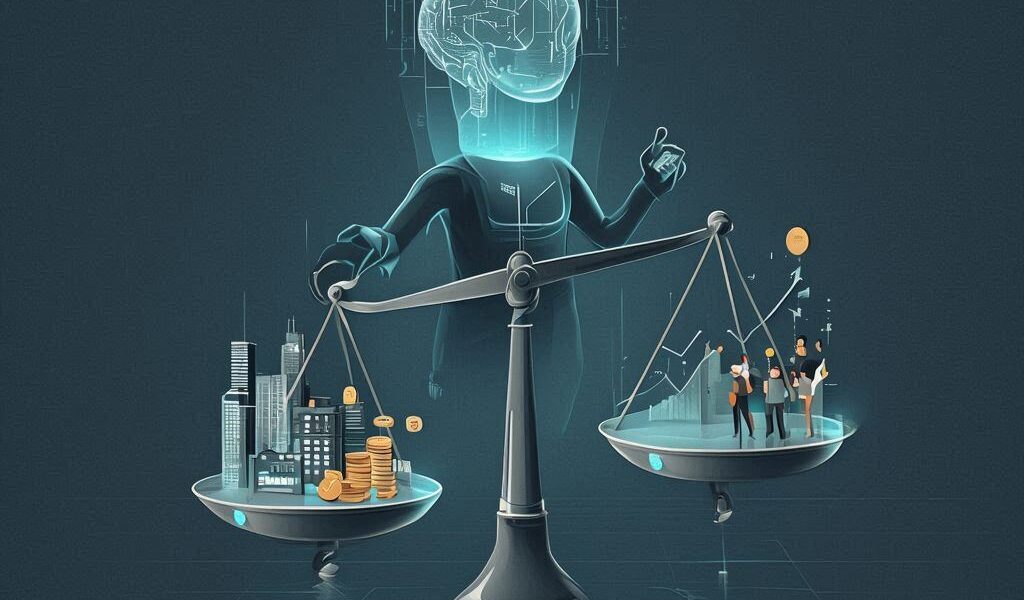
While “gerty” argues AI prevents stagnation, a critical review must address two major economic risks that could lead to a different kind of “stagnation” (wealth concentration):
- The “Winner-Take-All” Effect: If AI leads to extreme market concentration where only a few “superstar firms” (like Google, Microsoft, or NVIDIA) capture all the productivity gains, the broader economy may stagnate due to a lack of competition.
- The Productivity-Pay Gap: Statistics from the Economic Policy Institute show that since the late 1970s, productivity has grown 3x faster than typical worker pay. If AI boosts productivity but wages remain flat, the “progress” mentioned in the blog will not be felt by the general population, leading to social and economic instability.
Conclusion
I generally agree with the blog’s premise that AI is a tool for progress, provided the focus remains on Innovation (creating new things) rather than just Optimization (doing old things with fewer people).
The verified statistics from PwC and Goldman Sachs suggest a massive “progress” tailwind. However, for this to fuel sustained progress and not just a corporate balance sheet expansion, the gains must be distributed through labor market retraining and competitive policy.

One thought on “AI and Economic Growth: Critical Analysis of How Artificial Intelligence Drives Innovation and Productivity”