
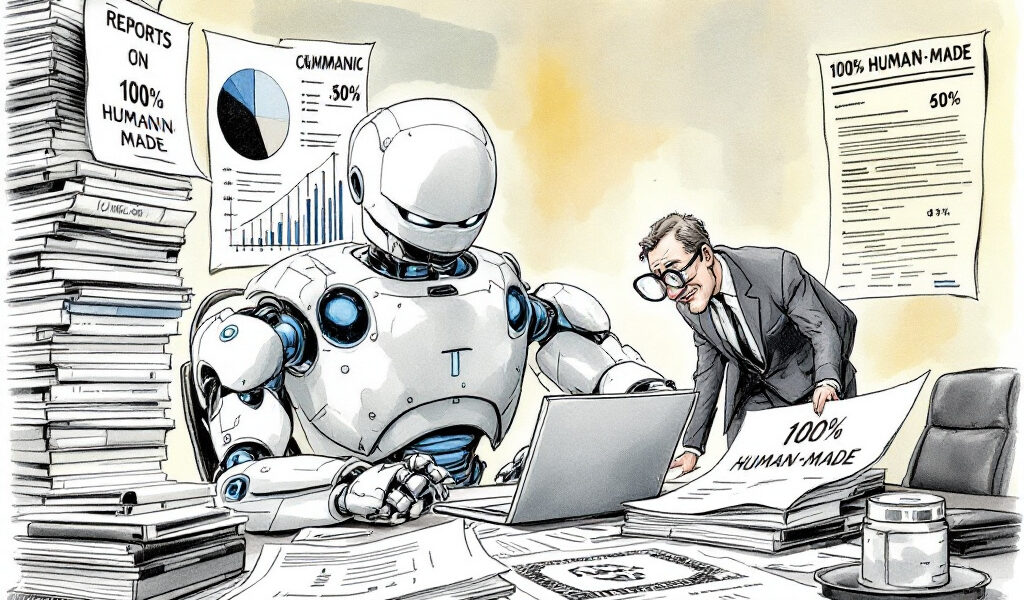

We asked Gerty (Mistral) to review the recent E&Y report Next phase of AI governance: closing the confidence gap. Our prompt was: “Review the attached report from E&Y. Attempt to determine how much of it was written by AI. Write an article to comment these findings.”
A forensic read of “Realizing potential: confidence in AI” — EY’s US AI Risk and Governance Survey, September 2026
In September 2026, EY published the inaugural edition of its US AI Risk and Governance Survey, an 18-page report on how large companies govern artificial intelligence. It is, on its face, a polished piece of thought leadership: a survey of 202 senior AI decision-makers at $1B+ publicly traded companies, a crisp thesis (AI governance has entered its “confidence gap” phase), and the kind of design that consulting budgets buy.
It also reads like something else. The question this article asks is simple: how much of it was written by a machine?
The short answer
No analysis can prove AI authorship conclusively — AI detectors are notoriously unreliable, and good human writers can sound formulaic too. But when the fingerprints are this dense, the reasonable conclusion is not whether an LLM was involved, only how much. My assessment, based on a quantitative and qualitative read of the report’s roughly 2,200 words of narrative prose: a large majority of the narrative text — plausibly 70% to 90% — was either drafted by a large language model or heavily rewritten with one. The humans, on the evidence, supplied the survey data, the structure, the sign-off, and a minority of the sentences.
The evidence
I ran a stylometric pass over the ten narrative sections of the report. Here is what the text gives away.
1. The rule of three, everywhere. The triadic list — “X, Y and Z” — is the signature cadence of LLM prose, and this report contains 21 of them in 99 sentences. “Trigger workflows, make decisions and take actions.” “The brand, financial and operational risks.” “Ambition with evidence, speed with accountability and innovation with trust.” One in five sentences carries a triad. Human writers use the rule of three; machines reach for it reflexively, and almost never leave a section without one.
2. Refrain density. The phrase “confidence gap” appears five times, “keep pace” five times, “as intended” three times, “governance design” three times. A coined concept repeated as a drumbeat is exactly what you get when a report is generated from a thesis prompt — “write a report with this through-line” — rather than written toward a conclusion.
3. The antithesis reflex. The report’s sentences repeatedly resolve into balanced opposition, the LLM’s favorite rhetorical move: “The challenge today is no longer whether governance exists. It is whether governance can keep pace with AI.” “Assurance will need to focus less on whether a control has been designed and more on whether it can identify and interrupt autonomous activity.” “The debate around AI governance is over.” Even the title of the coinage — confidence gap — is a contradiction compressed into two words, the purest form of the machine-generated concept.
4. Near-verbatim recycling. The body text of page 10 and page 12 share the same 20-plus-word sentence about the 72% worried about AI regulation, and the same clause about the 36% who experienced a materially negative AI incident — “data loss, financial damage, operational disruption and brand damage” appears twice, word for word. Page 10’s closing sentence is then lifted verbatim into its own pull-quote. Copy-paste across sections is what happens when pages are drafted separately — often by separate prompts — and no one deduplicates the prose.
5. The question template. Three sections end with an identical device: “ORGANIZATIONS SHOULD ASK: [rhetorical question].” Perfectly parallel structures, perfectly repeated, is the behavior of a template being filled.
6. Numeric inconsistency. The report renders percentages both as numerals (“36%”, “64%”) and as words (“Thirty-six percent”, “Sixty-four percent”), on different pages. Multiple drafting passes, likely separately prompted, left the seams visible.
7. What’s missing is also a tell. There are almost no contractions, no idiosyncratic metaphors, no digressions, and — notably — no em-dashes. This is the prose of a recent-generation model under a corporate style guide, or a model whose most recognizable tics were edited out. The flat, frictionless competence is itself evidence: humans writing under deadline leave burrs. This text has none.
The counter-evidence, to be fair. A few passages sound genuinely human. “Just as assurance professionals feel they’ve caught up, internal clients demand the next frontier in AI” carries an insider’s aside and a contraction — the closest thing to a voice in the document. And the pull-quote repetition of body statistics is standard report design, not a smoking gun by itself. The methodology section’s numbers also cohere: for n=202, a ±7-point margin of error at 95% confidence is arithmetically correct. Someone checked the math.
The estimate, and its limits
Weighing the markers, here is the honest breakdown:
- Human, with high confidence: the survey instrument, the data, the methodology, the legal boilerplate, the design, and the strategic decision to publish a report whose thesis is that assurance must become “a recurring source of evidence.”
- Machine-assisted, with high confidence: the executive summary and the narrative sections in between, where the triads, refrains, recycled clauses and templated structures are pervasive rather than occasional.
- Genuinely ambiguous: the key takeaways, which read like a human-edited compression of machine text — the four-bullet list and the “Where is it working / where is it being stretched” triple question are machine cadences, but the sentence-level polish suggests a curator’s hand.
Hence the 70–90% estimate for the narrative prose. I want to be clear about what that claim is not: it is not an accusation of misconduct. Using LLMs to draft thought leadership is now standard practice at every large professional services firm, and there is nothing deceptive about it per se. It is an inference from style, not a confession extracted from the page.
The irony that writes itself
What makes this document remarkable is not the AI authorship. It’s the disclosure asymmetry buried on page 18.
The methodology section states, with visible pride: “This research was conducted by human researchers among human respondents. The fielding process was thoroughly supervised and screened for bots and AI agents to deliver the highest quality of data.”
So the one thing EY certifies as human is the data. The prose — the 2,200 words that interpret, frame, and sell the findings — carries no such certification. The report is an audit of everyone else’s AI governance that is silent about the AI in its own production. A firm whose thesis is that “the ability to demonstrate control effectiveness becomes as important as the control itself” publishes a report without disclosing its own writing controls.
There is a second irony, one level deeper. The survey’s core finding is that organizations have governance on paper but lack confidence that it works in operation — policy exists, but is bypassed; registries exist, but leave blind spots; accountability is defined, but dissolves when agents act autonomously. That is a fair description of the report’s own authorship: humans are listed as authors (Richard J. Jackson, John McLain, both EY AI leaders), but the sentences under their names show the recognizable behavior of a system that drafted “without real-time human intervention” and was then reviewed. The document is its own case study.
What this means for the industry
Three implications are worth stating plainly.
Disclosure norms are arriving, whether the industry wants them or not. If a firm asserts human provenance for its survey data, the same readers will eventually expect a sentence about how the report was drafted. The first firm to add “This report was drafted with AI assistance and reviewed by the named authors” to its methodology page will have done more for AI transparency than a hundred pages of governance frameworks.
Assurance markets run on trust in the auditor’s own work. An audit opinion written by the same class of machine that wrote the system under audit is not a scandal — but it is a question clients will ask, and “our researchers are human” is not an answer to it.
Style is becoming evidence. The telltale cadences quantified here — triad density, refrain repetition, recycled clauses — are now part of how readers read. Organizations that deploy AI to write their public-facing material should assume that their audiences can tell, because increasingly, they can.
A final confession
The reader will have noticed the trap in this assignment: an AI was asked to estimate how much of a report was written by AI, and an AI is now writing the verdict. Fair. The methods used here — counting triads and refrains, hunting duplicated clauses — are mechanical and checkable by anyone with a copy of the PDF; the judgment layered on top is mine, and I have flagged its limits. But the meta-observation is the article’s real conclusion: in 2026, the question “who wrote this?” has stopped having a binary answer. EY’s report is likely the product of humans and a machine in close collaboration — data from people, prose from a model, judgment somewhere in between. That is not the exception anymore. It is the operating model, and it deserves governance of its own. Including, one day soon, a methodology note that says so.
Sources: “Realizing potential: confidence in AI” — EY US AI Risk and Governance Survey, September 2026 (all quotations and statistics drawn from the report; stylometric figures computed from its narrative text: 2,208 words, 99 sentences, average sentence length 22.3 words, 21 triadic constructions, 29 repeated six-word sequences).



One thought on “The Machine in the Room: How Much of EY’s AI Survey Was Written by AI?”