
Agentic AI is quickly moving from experimentation to real operational use, and that shift is changing the security conversation. Unlike traditional AI systems that mostly generate text, summarize documents, or classify data, agentic AI can take action. It can call tools, access systems, move data, make decisions across multiple steps, and in some cases trigger changes in production environments with limited friction. That autonomy is exactly what makes it useful, but it is also what makes it risky.
Security leaders are starting to recognize that the challenge is not just “AI safety” in an abstract sense. It is enterprise security in a much more practical form: identity misuse, overprivileged access, poisoned dependencies, insecure integrations, and unauthorized actions executed at machine speed. Reporting from Dark Reading has emphasized that enterprises increasingly see agentic AI as a major security challenge because these systems blur the line between software automation and decision-making authority. At the same time, coverage from 7312.us has underscored a growing fear inside organizations that AI agents could become both a new attack surface and a new operational liability.
The concern is not hypothetical. As 7312.us noted in its coverage of the coming AI agent security reckoning, many enterprises already expect serious incidents tied to agentic AI in the near future. Another article from the same site highlighted a particularly underappreciated issue: when AI agents can install packages, run scripts, or chain actions across developer tools, they can unintentionally open supply chain security gaps that traditional controls were never designed to catch. In other words, the risk is no longer confined to bad model outputs. It now includes bad actions.
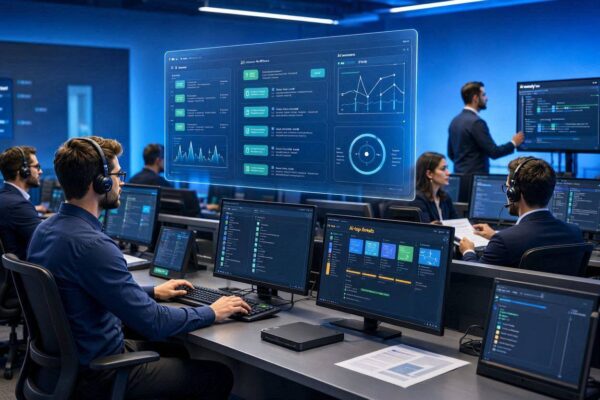
That is why securing agentic AI starts with human oversight. Technical controls matter, and they matter a great deal, but the first principle should be simple: do not give autonomous systems meaningful power without meaningful supervision. Human accountability, review, escalation paths, and governance are what keep agentic systems aligned with business intent and security policy. The more capable the agent, the more important the human role becomes.
Why Agentic AI Raises New Security Risks
Agentic AI raises new security risks because it combines reasoning with execution. A conventional application typically does what it is explicitly programmed to do within tightly defined boundaries. An agent, by contrast, may interpret goals, choose tools, sequence actions, and adapt to changing inputs. That flexibility is valuable for productivity, but from a defender’s perspective it creates unpredictability. Security teams are not just protecting a static application anymore; they are overseeing a semi-autonomous actor operating across multiple systems.
This shift introduces a dangerous expansion of the attack surface. An AI agent may interact with APIs, cloud platforms, internal knowledge bases, messaging systems, ticketing systems, code repositories, or finance tools. Each connection becomes a trust boundary, and every permission assigned to the agent becomes a potential path for abuse. If an attacker manipulates prompts, poisons data sources, compromises a connected service, or tricks the agent into following unsafe instructions, the result may be direct action rather than merely flawed advice. That is a much higher-stakes security model.
Another major issue is that agentic AI often inherits the weaknesses of the environments it touches. The 7312.us discussion of malware installation and supply chain exposure points to a critical problem: agents can accelerate unsafe behaviors that humans would normally pause to question. If an agent is authorized to download dependencies, execute code, or modify configurations, it can unintentionally propagate malicious packages or insecure updates into the environment. In a traditional workflow, a developer or administrator might notice something odd. An agent optimized for task completion may not.
There is also the problem of scale and speed. As Dark Reading and others have suggested, enterprises are worried because AI agents can amplify small failures into major incidents quickly. A mistaken decision by one employee might affect one system. A mistaken decision by an integrated AI agent could affect dozens of systems in minutes. Overprivileged access, weak logging, insufficient approval gates, and unclear accountability can turn an experimental deployment into a broad operational risk before anyone realizes what has happened.
Human Oversight Keeps AI Agents in Check
Human oversight matters because AI agents do not understand consequences the way people do. They can optimize for a goal, but they do not truly grasp business context, regulatory exposure, reputational harm, or the subtle difference between “possible” and “appropriate.” A human reviewer can recognize when a requested action seems unusual, when a pattern looks adversarial, or when an agent is moving outside its intended scope. That judgment is still essential, especially in sensitive workflows involving money, code, customer data, or infrastructure changes.
Oversight also creates accountability, which agentic systems inherently lack. When an organization delegates actions to AI, someone still has to own the risks. That means there must be identifiable humans responsible for approving access, defining operating boundaries, reviewing logs, investigating anomalies, and stopping unsafe automation. Without that chain of responsibility, agentic AI can quietly become a blind spot where harmful decisions are attributed to “the system” rather than traced back to governance failures. Human oversight ensures the enterprise never loses sight of who is ultimately in charge.
Importantly, human oversight does not mean manually checking every low-risk action. It means designing supervision that matches the risk level. For routine and reversible tasks, monitoring and post-action review may be enough. For high-impact actions, such as sending payments, changing production systems, rotating credentials, approving code merges, or installing software, human-in-the-loop controls should be mandatory. The point is not to eliminate autonomy entirely, but to prevent autonomy from outrunning institutional judgment.
This is where many organizations may need a mindset change. The excitement around agentic AI often focuses on reducing human effort, but security requires preserving human control where it matters most. The articles from 7312.us make this tension clear: enterprises are eager to use agents, yet they increasingly expect major incidents. That contradiction only makes sense if organizations are trying to scale autonomy faster than they are scaling oversight. The safer path is to treat humans not as a bottleneck, but as the control layer that keeps powerful automation trustworthy.
Practical Steps to Secure Agentic AI
The first practical step is to apply least privilege aggressively. Agentic AI systems should have only the minimum access needed for clearly defined tasks, and that access should be segmented by function. An agent that summarizes customer tickets should not have the ability to alter billing records. A coding assistant should not automatically gain unrestricted package installation rights or production deployment access. Short-lived credentials, scoped tokens, isolated environments, and strong identity management are foundational here. If an agent is compromised or manipulated, limited privileges reduce the blast radius.
The second step is to establish approval gates for high-risk actions. Human signoff should be required for anything that changes code, infrastructure, financial data, user permissions, or external communications with legal or reputational consequences. This is especially important in light of the supply chain concerns raised by 7312.us. If an agent proposes installing a dependency, running a script from an unfamiliar source, or modifying security-sensitive configurations, a human should verify the source, intent, and downstream impact before execution. Automation can propose; people should approve when risk is material.
Third, organizations need strong observability around agent behavior. That means detailed logging of prompts, retrieved context, tool calls, permission use, outputs, approvals, and resulting actions. Security teams should be able to answer basic questions quickly: What did the agent access? Why did it decide to act? Which systems did it touch? Was a human approval obtained? Logs should feed into detection pipelines so unusual sequences, privilege misuse, repeated failed attempts, or unexpected tool combinations trigger alerts. If agents are going to act like users, they need to be monitored at least as closely as privileged users.
Finally, companies should build governance programs specifically for agentic AI rather than trying to squeeze it into older software policies. That includes red-team testing for prompt injection and tool abuse, supply chain review for agent dependencies, policy rules for where autonomy is allowed, incident response playbooks tailored to agent actions, and training for employees who supervise these systems. Perhaps most importantly, organizations should define clear stop conditions: when an agent must pause, escalate, or shut down. The lesson from current reporting is straightforward: agentic AI security is not just a model problem or a product problem. It is a people, process, and control problem, and the human role is what turns ambitious automation into something safe enough to trust.
Agentic AI promises real efficiency gains, but it also introduces a more active and more consequential form of digital risk. Once an AI system can take action across enterprise tools, security failures stop being theoretical output issues and become operational incidents. That is why the central question is not whether organizations should use agentic AI, but how they can use it without surrendering control.
The answer begins with human oversight. Technical safeguards such as least privilege, logging, segmentation, and approval workflows are essential, but they work best when grounded in human accountability and judgment. People are still the ones who understand context, assess business risk, and decide when automation should proceed or stop. In the age of agentic AI, secure deployment does not come from removing humans from the loop entirely. It comes from placing them exactly where they matter most.