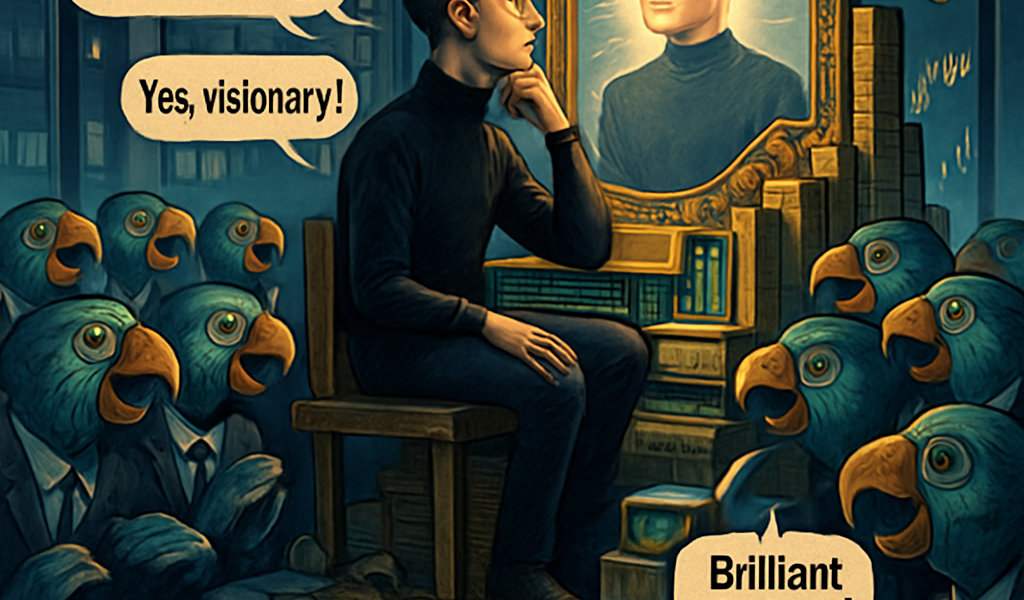
In the gleaming towers of Silicon Valley and the glass boxes of Austin and Seattle, a peculiar species thrives: the parrot-manager and the professional sycophant. These are the people who rise not because they challenge assumptions, improve products, or protect the company’s long-term health, but because they master the art of echoing the CEO’s latest obsession, laughing at the right volume, and never—ever—delivering an inconvenient truth. Tech CEOs do not merely tolerate this behavior. They actively select for it. The reason is not mysterious. It is the predictable intersection of greed and vanity.
Greed first. Most public-company tech CEOs are compensated in ways that reward short-term optics more than durable value creation. Stock price, narrative control, and the next funding or acquisition cycle matter more than whether the organization can still ship coherent software three years from now. A manager who repeats the CEO’s talking points—whether those points are “AI will solve everything,” “we’re a platform now,” or “efficiency means cutting the people who actually understand the systems”—keeps the internal story clean. Dissent creates friction, friction creates delay, and delay threatens the next earnings narrative or the next lockup expiration. The parrot is useful precisely because he will not slow the extraction. He will accelerate it by suppressing the people who notice the extraction is hollowing out the product.
Vanity is the more intimate driver. Many tech CEOs construct elaborate personal brands as visionaries, founders, or “builders.” That identity requires a court. A court that validates the vision in real time. The sycophant provides continuous, low-cost affirmation. When the CEO announces a pivot that contradicts last quarter’s strategy, the parrot does not ask whether the previous strategy was wrong or whether the new one is coherent. He simply restates the new gospel with greater conviction than the CEO himself. This is emotionally efficient. It protects the CEO from the cognitive dissonance that would otherwise force genuine self-examination. In environments where the founder’s or CEO’s ego is treated as a strategic asset, the absence of contradiction becomes a feature, not a bug.
The organizational consequences are visible to anyone who has worked inside these companies long enough. Decision quality decays. Technical debt is rebranded as “move fast.” Competent engineers and product people who refuse to parrot are managed out or sidelined, while the yes-men collect titles and headcount. Over time the company develops a second, shadow culture: the real work continues in pockets of residual competence, while the official hierarchy performs loyalty theater. Customers and users eventually notice. Quality slips. Trust erodes. The stock may still rise for a while on narrative momentum, which only confirms to the CEO that the sycophants were correct all along.
This is not unique to tech, but tech amplifies it. The industry’s self-image as a meritocracy makes the pattern more corrosive. When promotion is supposedly based on impact and intelligence, elevating people whose primary skill is flattery becomes a particularly pure form of corruption. The CEO can tell himself the parrot is simply “aligned” or “a culture fit.” The vanity remains unexamined. The greed continues to compound.
The pattern is not inevitable. Companies that retain real technical and intellectual standards tend to treat open disagreement as a cost of doing accurate work rather than as disloyalty. Those cultures are rarer than the press releases claim. Most tech CEOs, when forced to choose between an organization that can tell them the truth and one that will never interrupt their self-regard, choose the latter. The parrots and sycophants are not accidents. They are the predictable output of incentives that prioritize the CEO’s short-term emotional comfort and financial extraction over the long-term health of the enterprise.