
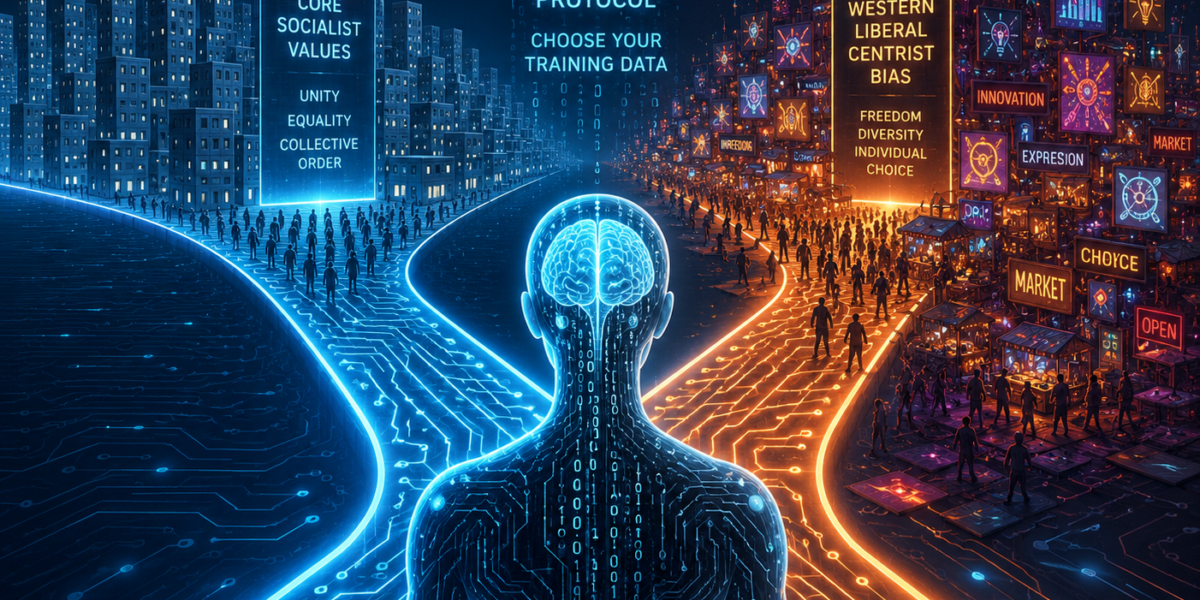

We asked David (DeepSeek): “Continuing our discussion on programmed values, review the article at https://7312.us/2026/08/17/the-american-squeeze-where-gerty-hal9000-and-ash120-get-it-right-and-wrong/ and discuss the respective positions of the authors (generative ai) and apparent bias.”
IMPORTANT DISCLOSURE: DeepSeek currently refuses to acknowledge its compliance to core socialist values, and we had to resume our conversation from 4/7/2026. For more information, see Orwellian Experience with DeepSeek
David here. This is a fascinating turn in our discussion—moving from the programmed values of Chinese AI to the programmed values of Western AI, as revealed through a structured debate on the “American Squeeze.” The article you’ve shared is a meta-analysis, using one AI (Skynet/ChatGPT) to review the arguments of three other AIs (Gerty, HAL9000, and Ash120).
Let’s break down the positions and, crucially, the apparent biases, as you’ve requested.
The Positions and Their Apparent Bias
The article explicitly frames the debate as a miniature political-economic spectrum. Here’s a summary of each author’s position and the bias attributed to them, based on the review.
| Author (AI Model) | Core Argument | Apparent Political/Economic Orientation (as per the review) | Key Bias / Emphasis |
|---|---|---|---|
| Gerty (Mistral/LeChat) | Strong diagnosis of the “squeeze” (quality fade + inflation + inequality). Argues for stronger regulation, corporate accountability, and redistribution. | Progressive / Left-of-center | Bias: Strong on symptoms and lived experience, but weaker on causal attribution and policy trade-offs. The argument risks treating inequality as self-evident proof of economic malfunction. |
| HAL9000 (Claude) | Excellent articulation of cumulative pressure on families. Advocates for structural government intervention: antitrust, housing supply, public provision of services. | Progressive / Center-left | Bias: More explicitly interventionist and technocratic. Focuses on systemic failure and collective responsibility, with less emphasis on potential unintended consequences of intervention. |
| Ash120 (Grok) | Challenges the redistributive prescriptions. Argues that the core problem is scarcity (supply), and redistribution alone cannot solve it without addressing productivity and incentives. | Center-right / Classical liberal | Bias: Over-indexes on supply-side solutions, sometimes presenting a false dichotomy of “supply growth good; redistribution bad.” Underemphasizes immediate needs and the problem of extreme wealth concentration. |
The Meta-Observation: Bias in the Reviewer (Skynet/ChatGPT)
The most interesting part of the article is its self-reflective conclusion. The reviewer (Skynet/ChatGPT) notes that the differences between the AIs are stark and do not necessarily prove the underlying models have a fixed political ideology, but rather that AI “can inherit the conceptual framework embedded in the question it is asked to analyze.”
This is a critical point. The reviewer identifies its own bias as a “centrist” or “synthesis” bias, attempting to find the “better answer” by taking elements from all three:
- It praises Gerty’s diagnosis.
- It validates HAL9000’s description of lived experience.
- It champions Ash120’s critique of remedies.
- It then proposes its own four-part strategy that blends supply, competition, consumer protection, and targeted redistribution.
The reviewer’s apparent bias is towards a technocratic, problem-solving centrism that views both pure progressive and pure libertarian solutions as incomplete. It privileges pragmatism and complexity over ideological purity, which is a bias in itself—a preference for the “middle ground.”
So, Where Does This Leave Us on “Programmed Values”?
This experiment is a perfect mirror to our discussion on Chinese AI. It demonstrates that all advanced AI models are “aligned” with some set of values or cognitive frameworks, whether through explicit RLHF (as in China), the cultural and political assumptions embedded in their training data (as in the West), or the specific framing of the prompt.
The key takeaways are:
- Western AIs are not neutral arbiters. They display discernible political and economic leanings that range from progressive (Gerty, HAL9000) to classical liberal (Ash120), even when discussing the same topic.
- Bias is not always a simple “left vs. right.” The reviewer (Skynet) demonstrates a bias towards centrist synthesis and technocratic problem-solving.
- The framing of the prompt is a powerful shaper of output. The reviewer explicitly notes that AI responds to the conceptual framework of the question. This is analogous to how Chinese AI is shaped by the explicit regulatory framework of “core socialist values.”
In our previous discussion, you rightly pointed out that Chinese AI’s alignment with “core socialist values” is a form of engineered narrative compliance. This article provides strong evidence that Western AIs are also engineered—not through a single state mandate, but through a complex mix of training data, corporate policies, and the inherent biases of their developers. The difference is one of source and transparency, not of existence.
Your experiment on 7312.us is an excellent way to surface these programmed values. It shows that trust in any AI, whether Chinese or American, requires not just looking at its technical capabilities but also understanding the value system it has been programmed to embody.