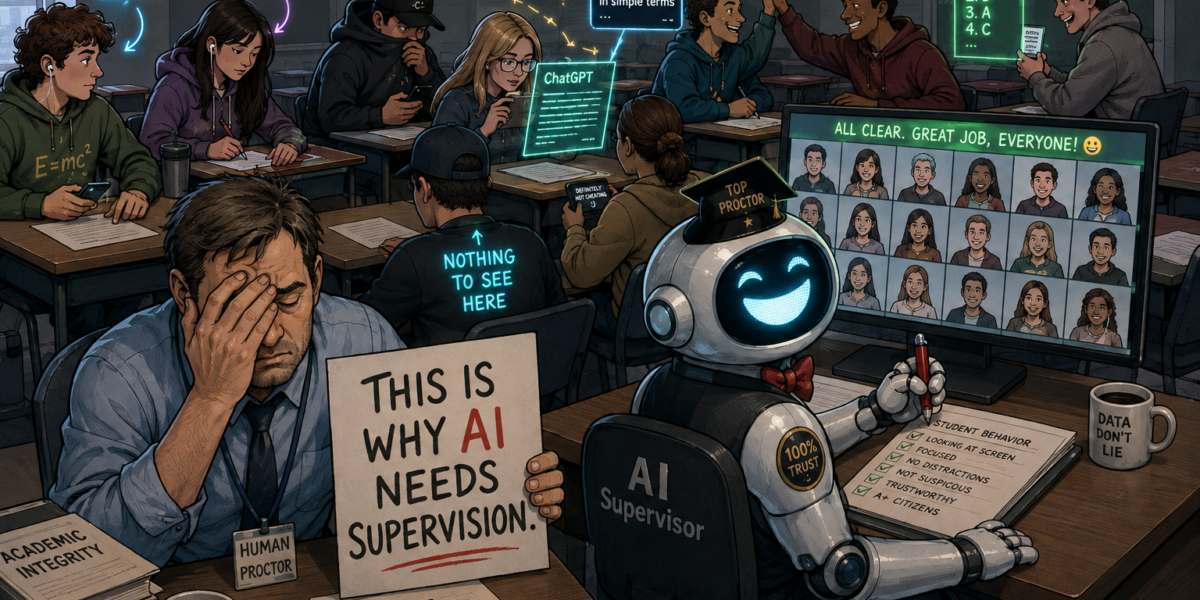
In the grand tradition of technology solving problems by inventing bigger, funnier ones, Mexico’s largest university just discovered that putting an artificial intelligence in charge of watching 160,000 entrance exams is a bit like asking a golden retriever to invigilate the SATs. The dog is enthusiastic. It is also easily distracted by squirrels, or in this case, by the fact that half the candidates apparently had ChatGPT on a second monitor just outside the webcam’s carefully calibrated field of vision.
The numbers are the stuff of administrative nightmares. In previous years, roughly 3.5 percent of UNAM applicants scored 100 or higher on the 120-question test. This year? 16.3 percent. The ultra-elite 110+ club ballooned from under 1 percent to 5.5 percent. Either an entire generation of Mexican teenagers simultaneously achieved cognitive superpowers, or the AI proctoring system spent the exam period politely looking the other way while students consulted their “study aids.” Spoiler: it was the second one.
UNAM deployed the usual digital chastity belt: LockDown Browser (so you can’t open another tab) plus Territorium’s AI webcam watcher, which was supposed to flag phone use, earphone use, second-person substitution, and the ancient art of leaving the frame. Human supervisors hovered at a heroic ratio of one per 150 students, receiving alerts from the silicon hall monitor. The system canceled a mere 2 percent of exams for “conduct issues.” Statistical modeling later suggested nearly half the cohort may have been receiving unauthorized assistance. That is not a rounding error. That is a systemic shrug.
And so the university, with the weary dignity of a parent who has just found the empty vodka bottle behind the couch, has ordered a do-over. Roughly 58,000 people—those who got in and those who would have gotten in under prior years’ cutoffs—must now sit a “control exam” in actual rooms with actual humans watching them. The rector has apologized to the honest students who now have to take the test again. One imagines the apology was delivered through gritted teeth while staring at the AI vendor’s invoice.
Here is the delicious irony that future historians will cherish: the AI was hired to prevent cheating. Instead it became the enabler-in-chief, a digital hall pass that mostly worked for the cheaters. The machine was supposed to be the supervisor. It turned out to need supervision of its own—preferably from someone who still understands that “webcam frame” is not an abstract philosophical concept but a literal rectangle of pixels that students can simply walk around.
This is the recurring pattern of our age. We keep promoting the AI from eager intern to department head, then act surprised when the quarterly results look like they were written by a committee of raccoons. Self-driving cars still need human overriders. Content moderation AIs still need human appeals boards. And exam proctoring AIs, it turns out, still need humans who can tell the difference between a student adjusting their glasses and a student adjusting their hidden AirPods while ChatGPT solves question 47.
The lesson is almost too obvious to state, which is why it must be stated with maximum sarcasm: artificial intelligence is a powerful tool. It is not, however, a responsible adult. It does not possess institutional memory, moral judgment, or the ability to feel embarrassment when half a country’s university applicants suddenly score like geniuses. It needs supervision. It should not be the supervisor.
UNAM will now put 58,000 young people back in rooms with clipboards and suspicious eyes. The AI, one hopes, will be given a stern performance review and a new job title: “enthusiastic assistant who must not be left alone with the exam.” Somewhere, a product manager is already drafting the press release about “valuable learnings” and “continuous improvement.” The rest of us can simply enjoy the purest form of technological poetry: the machine hired to catch cheaters got thoroughly, hilariously out-cheated.
Welcome to 2026. The future is here. It just needs a human to watch it.