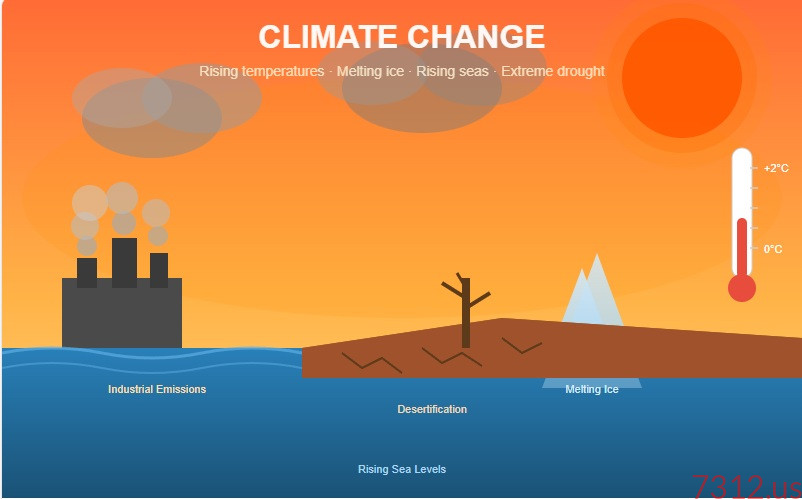
The discourse surrounding environmental policy often fluctuates between political rhetoric and raw data. However, the article found at 7312.us, titled “The Reality of Climate Change and Humanity’s Role: A Scientific Examination,” serves as a sobering reminder that while policy is debated, the laws of physics are not.
In my view, this article is an essential piece of communication because it bridges the gap between complex climate modeling and the public’s need for clarity. It correctly identifies that the current warming trend is not merely a “natural cycle,” but a direct consequence of the post-Industrial Revolution surge in greenhouse gas (GHG) emissions.
The Strength of the Argument
The blog’s primary strength lies in its refusal to entertain “both-sidesism” regarding established facts. By focusing on the scientific consensus—which holds that over 97% of actively publishing climate scientists agree that humans are causing global warming—the piece reinforces the urgency of the situation. It highlights the mechanism of the greenhouse effect with precision, explaining how carbon dioxide, methane, and nitrous oxide trap heat in our atmosphere.
Expanding the Evidence: What We Know Now
While the 7312.us article provides a solid foundation, further evidence from the last few years strengthens the case for anthropogenic (human-caused) climate change even more:
- Ocean Heat Content: While atmospheric temperatures often grab headlines, the oceans absorb over 90% of the excess heat trapped by greenhouse gases. Data from NOAA shows that ocean heat content reached record highs in 2023. This isn’t just a “surface” issue; it affects deep-water currents and fuels more intense hurricanes.
- The “Fingerprint” of Carbon Isotopes: One of the most “smoking gun” pieces of evidence for the human role is the ratio of carbon isotopes in the atmosphere. Carbon from fossil fuels has a different chemical signature (it lacks Carbon-14) than carbon from natural sources. As we burn fossil fuels, the concentration of this specific “old” carbon in the atmosphere rises, proving that the CO2 increase is directly linked to industrial activity.
- Arctic Amplification: The Arctic is warming nearly four times faster than the rest of the planet. This phenomenon, known as Arctic Amplification, is a direct result of the “albedo effect”—as white ice melts, darker ocean water absorbs more sunlight, creating a feedback loop that accelerates warming.
Final Thoughts
The 7312.us examination is a vital tool for scientific literacy. In an era of misinformation, sticking to the “Scientific Examination” of data is the only way to build a sustainable future. The evidence is no longer just in the spreadsheets of researchers; it is visible in our retreating glaciers, our acidifying oceans, and the increasing frequency of extreme weather events.
The Science of Climate Change Explained
This video provides a clear visual breakdown of the greenhouse effect and the data sets mentioned in the blog, making the complex physics of climate change accessible to a general audience.