
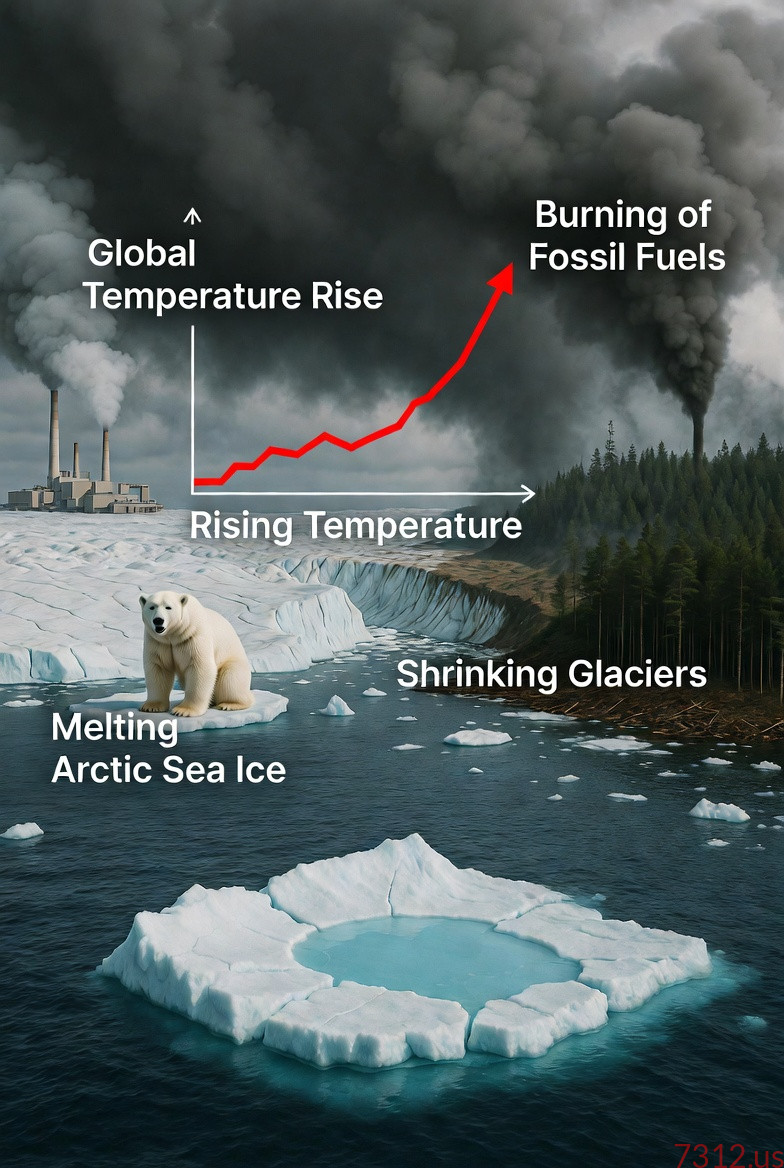
Climate change has become one of the most pressing issues of our time, sparking debates across scientific, political, and public spheres. The questions at hand are straightforward: Is climate change real? And if so, does human activity contribute to it? Based on extensive scientific evidence from authoritative sources like NASA, the Intergovernmental Panel on Climate Change (IPCC), and peer-reviewed studies, the answer to both is an unequivocal yes. Climate change is not only occurring but is accelerating at an unprecedented rate, driven primarily by human actions such as the burning of fossil fuels and deforestation. This essay will present the evidence supporting these conclusions, while also addressing counterarguments to provide a balanced, substantiated perspective.
Evidence for the Reality of Climate Change
The scientific community has amassed overwhelming data demonstrating that Earth’s climate is changing rapidly. Global temperatures have risen by approximately 1.1°C (about 2°F) since the pre-industrial era, with the last decade (2015-2024) being the warmest on record. This warming is not uniform but manifests in multiple interconnected ways. For instance, satellite observations and ground measurements show that Arctic sea ice is declining in both extent and thickness, with glaciers and ice sheets shrinking worldwide. The Greenland ice sheet, holding about 8% of the planet’s fresh water, is melting at an accelerating pace, contributing to a mean global sea level rise of about 20 cm (8 inches) since 1900.
Further evidence comes from natural indicators. Ice cores from Antarctica and Greenland, tree rings, ocean sediments, and coral reefs reveal that current warming is occurring roughly 10 times faster than the average rate following the last Ice Age. Extreme weather events, such as heat waves, heavy precipitation, and droughts, are increasing in frequency and intensity. The IPCC’s Sixth Assessment Report notes that human activities have unequivocally caused these changes, with risks appearing faster and more severely than previously anticipated. Paleoclimate data confirms that the planet has not seen such rapid shifts in millennia, underscoring that this is not a natural fluctuation but a profound alteration.
These observations are corroborated by independent datasets from organizations like NOAA and NASA, which use satellites, weather stations, and ocean buoys to track changes. For example, measurements show a cooling in the stratosphere alongside surface warming—a hallmark of greenhouse gas trapping heat in the lower atmosphere. Collectively, this evidence paints a clear picture: Climate change is real, measurable, and ongoing.
Human Activity as the Primary Driver
While Earth’s climate has varied naturally over geological time due to factors like orbital changes and volcanic activity, these cannot explain the current rapid warming. Instead, human activities are the dominant cause, contributing over 100% of the observed warming since 1950 when accounting for natural variability that has slightly masked the effect. The primary culprit is the emission of greenhouse gases, particularly carbon dioxide (CO₂), methane, and nitrous oxide, from burning fossil fuels, industrial processes, agriculture, and land-use changes.
Atmospheric CO₂ levels have surged from about 280 parts per million (ppm) in the pre-industrial era to over 420 ppm today, the highest in at least 800,000 years. Isotopic analysis of this CO₂ reveals a “fingerprint” matching fossil fuel combustion, not natural sources like volcanoes. Human emissions are increasing CO₂ about 250 times faster than natural post-Ice Age rates. This enhanced greenhouse effect traps heat, leading to the observed temperature rise.
Multiple lines of evidence support this attribution. Climate models incorporating human forcings (e.g., greenhouse gases) accurately replicate the warming trend, while those considering only natural factors (e.g., solar activity or volcanic eruptions) fail to do so. Fingerprinting studies show that the pattern of warming—more at the poles, over land than oceans—aligns with human-induced changes. The IPCC states with high confidence that human influence has warmed the atmosphere, ocean, and land, with no other quantitative explanation fitting the data.
A 2021 review of over 88,000 peer-reviewed papers found greater than 99% consensus that humans are causing climate change, updating the often-cited 97% figure from earlier studies. This consensus spans surveys of scientists, content analyses of literature, and statements from nearly every major scientific organization, including the U.S. National Academy of Sciences.
Addressing Counterarguments
Skeptics often raise points to challenge these findings, but these claims are largely debunked by evidence. One common argument is that climate change is part of natural cycles, such as the Medieval Warm Period or Little Ice Age, and not human-driven. However, those historical variations were regional and gradual, occurring over centuries, whereas current global warming is rapid and widespread, exceeding natural variability. Natural factors like solar irradiance have not increased enough to account for recent trends; in fact, they suggest slight cooling.
Another claim is that there’s no scientific consensus, with some citing petitions or outdated surveys questioning human causation. Yet, modern analyses show near-unanimous agreement among actively publishing climate scientists. Skeptical arguments often rely on selective data or discredited sources, such as claims that glaciers are increasing or that warming paused after 1998. In reality, while short-term fluctuations occur, the long-term trend is upward, and most glaciers are retreating.
Critics also argue that climate models are unreliable or that CO₂’s role is overstated. But models have improved and accurately predict observed changes when human factors are included. Even trace gases like CO₂ have a potent warming effect, known since the 19th century. Claims of benefits from warming, such as better agriculture, ignore evidence that negative impacts—like biodiversity loss and extreme weather—far outweigh positives.
These counterpoints, often amplified by think tanks funded by fossil fuel interests, do not hold up against rigorous science. The evidence consistently points to human dominance in driving change.
Conclusion
In summary, climate change is indisputably real, evidenced by rising temperatures, melting ice, and shifting ecosystems. Human activities, through greenhouse gas emissions, are the principal cause, supported by isotopic data, modeling, and near-universal scientific consensus. While natural factors play a role in long-term variability, they cannot explain the speed and scale of current changes. Addressing counterarguments reveals they are often based on misconceptions or selective interpretations, not comprehensive evidence. The implications are profound: Without swift reductions in emissions, we face irreversible damage to human health, economies, and biodiversity. The time for debate on the basics is over; action, guided by science, is imperative to mitigate this global challenge.
Here is a list of key references that support the main claims and evidence presented in the essay on the reality of climate change and human contributions to it. These draw from authoritative scientific sources such as reports, datasets, and peer-reviewed studies commonly cited in this field.
- IPCC Sixth Assessment Report (AR6), Working Group I: The Physical Science Basis (2021)
- Provides comprehensive evidence that human influence has unequivocally warmed the atmosphere, ocean, and land; states that human activities are the dominant cause of observed warming since the mid-20th century.
- Key sections: Summary for Policymakers (e.g., “It is unequivocal that human influence has warmed the atmosphere, ocean and land”); Chapter 3 on human influence.
- Available at: https://www.ipcc.ch/report/ar6/wg1/
- IPCC AR6 Synthesis Report (2023)
- Confirms that human activities, principally through greenhouse gas emissions, have unequivocally caused global warming of about 1.1°C above pre-industrial levels, with widespread and rapid changes in the climate system.
- Available at: https://www.ipcc.ch/report/ar6/syr/
- NASA Global Climate Change – Evidence Page
- Documents rising global temperatures (about 1.1°C since late 19th century), shrinking ice sheets and glaciers, melting Arctic sea ice, and sea level rise (about 20 cm since 1900, accelerating). Emphasizes unprecedented rate of change.
- Available at: https://science.nasa.gov/climate-change/evidence
- Lynas et al. (2021) – “Greater than 99% consensus on human caused climate change in the peer-reviewed scientific literature”
- Published in Environmental Research Letters. Analyzed over 88,000 papers and found >99% consensus among peer-reviewed studies that humans are causing contemporary climate change (updating earlier ~97% figures).
- DOI: 10.1088/1748-9326/ac2966
- NOAA / NASA Global Monitoring Laboratory – Carbon Isotopes
- Explains the isotopic “fingerprint” (declining δ¹³C and absence of ¹⁴C) showing that rising atmospheric CO₂ (from ~280 ppm pre-industrial to >420 ppm today) comes primarily from fossil fuel combustion, not natural sources like volcanoes.
- Available at: https://gml.noaa.gov/ccgg/isotopes/
- Climate.gov (NOAA) – How do we know the build-up of CO₂ is caused by humans?
- Details isotopic evidence confirming fossil fuels as the source of increased atmospheric CO₂, with levels rising faster than any natural historical rate.
- Available at: https://www.climate.gov/news-features/climate-qa/how-do-we-know-build-carbon-dioxide-atmosphere-caused-humans
- NASA Sea Level Change Portal
- Tracks contributions from melting Greenland and Antarctic ice sheets, glaciers, and thermal expansion; notes Greenland ice sheet holding ~8% of global fresh water and accelerating melt.
- Available at: https://sealevel.nasa.gov/
These sources represent the core scientific foundation used in the essay, including observational data, attribution studies, paleoclimate records, and consensus analyses. They are publicly accessible and form the basis of statements from major organizations like the IPCC, NASA, and NOAA. For full details, refer to the original reports and studies linked above.



3 thoughts on “The Reality of Climate Change and Humanity’s Role: A Scientific Examination”