
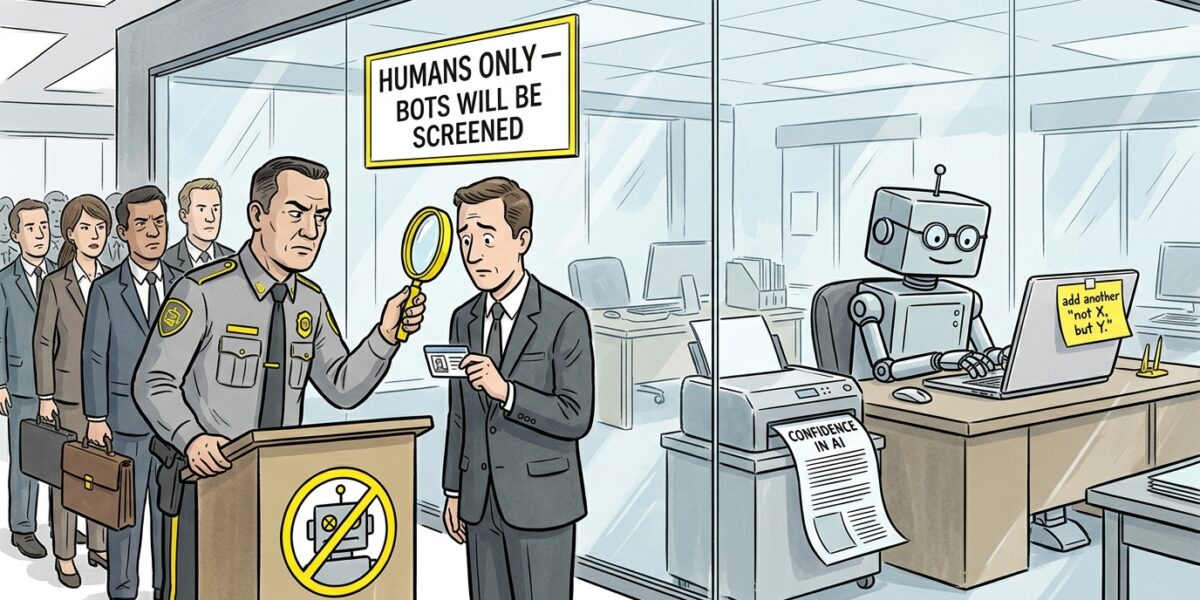

We previously asked Gerty to review a recent E&Y report for AI authorship. We asked the same question to Hal9000 (Claude): “Review the attached report from E&Y. Attempt to determine how much of it was written by AI. Write an article to comment these findings.”
My best estimate: the data in EY’s September 2026 Realizing potential: confidence in AI survey came from humans, and the framing prose very likely had a machine in the room. Call it roughly half of the narrative text showing heavy LLM fingerprints, concentrated in the executive summary, section transitions and key takeaways. That number is a judgment, not a measurement.
The best clue sits on the methodology page. EY assures readers the survey was run by human researchers among human respondents, with fielding screened for bots and AI agents. It is a careful chain of custody for the inputs. It says nothing at all about who, or what, wrote the outputs.
For a report whose central argument is that organizations can’t see where AI is operating inside them, that is a remarkable blind spot to leave on the last page.
How I read it
There is no reliable AI detector, and I didn’t pretend to run one. Commercial detectors misfire on exactly this genre: polished, committee-edited corporate prose. Consulting reports were the training data for the house style LLMs now produce, so the overlap cuts both ways.
What’s left is close reading. I went through the roughly 2,500 words of body text and counted recurring constructions, then looked for the opposite signal: the slips, clumsy edits and layout debris that come from people working under deadline. Neither list proves anything alone. Together they suggest a division of labor.
The case for a machine
The report opens by declaring that the debate around AI governance is over, then follows with three short sentences of settled fact. It is a confident, quotable rhythm. It is also the rhythm every frontier model reaches for when asked to write an executive summary.
| Pattern | Count | Example from the report |
| “Not X, but Y” reframes | ~11 | “The challenge today is no longer whether governance exists. It is whether governance can keep pace with AI.” |
| Triads and paired lists | ~8 | “pair ambition with evidence, speed with accountability and innovation with trust” |
| “Confidence gap” | 6 | Used as headline, transition and section opener |
| “[X] matters, because” | 2 | “That distinction matters, because…” / “This data point matters, because…” |
| Anaphoric triplets | 1 run | “Controls can exist and still be bypassed. Registries can be created and still leave blind spots. Accountability can be defined broadly and still become unclear…” |
| “Organizations should ask” boxes | 4 | Each restates a sentence already in the body |
The structural tell is stronger than any phrase. The 72% regulatory-compliance figure appears three times, twice within two pages. The 36% “materially negative incident” figure is restated almost word for word in two sections. Each section re-establishes context as though the reader had just arrived.
That is how text looks when it is generated section by section from the same brief and stitched together. Each prompt is told the key statistics; each output dutifully uses them. A single human author would usually notice the third repetition and cut it.
The case for a human
Models are fluent to a fault. They rarely drop a word or break agreement. This report does both, and the errors cluster in the data-heavy paragraphs.
- “Respondents cite these risks span a spectrum of vulnerabilities…” A missing “that”, the kind of seam left when someone edits a sentence in place.
- “41% say senior AI decision-makers do not have visibility…” Every respondent is a senior AI decision-maker. The sentence reads like a questionnaire label pasted into prose by someone who knew what it meant.
- “AI governance has been designed, but not yet been operationalized.” A doubled auxiliary in a section headline, set in giant yellow type.
- “Ernst &Young” in the legal footer, missing its space.
- “FORMATTING BUTTONS” printed on four divider pages: a layer name leaking out of the design template.
The agentic section also carries a distinctly human consulting voice. The line about assurance professionals feeling they’ve caught up just as internal clients demand the next frontier is wry and specific. It reads like a partner who has sat through those meetings.
Verdict: a hybrid, with a pattern
The likeliest workflow is a familiar one in 2026. Analysts produced the numbers and drafted the findings paragraphs. A model was then used to write or heavily polish the framing: the opening, the section openers, the takeaways and the callout boxes.
| Part of the report | Signal | Likely authorship |
| Survey design, fielding, charts | Methodology, real MOE, rounding notes | Human |
| Data paragraphs (stats stacked in sentences) | Grammar slips, garbled attributions | Mostly human, edited |
| Executive summary and key takeaways | Reframes, triads, slogan endings | Mostly machine-drafted |
| Section transitions and “should ask” boxes | Restated stats, duplicated sentences | Machine-assembled |
Weighted by word count, that puts somewhere between 40% and 60% of the narrative prose in machine-shaped territory. Treat the range as wide on purpose. Someone could have written all of it by hand after reading too many model outputs, which is its own kind of contamination.
None of this is a scandal. Using AI to draft a report about AI is sensible, arguably required. The problem is narrower: the report discloses its controls on respondents and is silent on its own production.
The numbers deserve more scrutiny than the prose
Whoever wrote the sentences, the figures underneath them have problems a careful reader should flag.
The detection paradox. The headline says 26% of agentic-AI users admit they cannot detect unauthorized agents. The more striking number is the implied 74% who believe they can. Nobody can count the agents they failed to detect. The same logic applies to the 59% implicitly claiming full visibility into every AI tool in the building.
Two answers to one question. The governance chart shows 73% have “performed a formal AI review”, with 22% still in progress. Five pages later, 98% say they conduct formal AI assurance reviews at least annually. The questions were probably worded differently. The report never reconciles them.
A number that undersells itself. The report says 80% review monthly or quarterly. Its own donut chart adds another 14% reviewing more often than monthly, so roughly 94% review at least quarterly. Odd framing for a firm that sells assurance.
Invisible subgroups. The ±7-point margin applies to all 202 respondents. Every agentic finding (85%, 56%, 49%, 39%, 26%) comes from a smaller subgroup whose size is never stated, so their real margins are wider and unknown.
Who’s grading whom. Respondents are senior leaders rating governance they own, in a survey commissioned by an assurance practice. Its conclusion is that organizations need more independent assurance. That may be true. It is also the product on the shelf.
Apply the report to the report
EY closes by urging leaders to ask where governance is working, where it is stretched, and where assurance can close the gap. Those questions fit the document itself rather well.
- Inventory: Which sections were drafted or edited with AI, and with which tools?
- Ownership: Who signed off on the final prose, as opposed to the data?
- Evidence: What review caught the repeated statistics, the 73%-versus-98% gap, or the missing “that”? Apparently none.
A one-line disclosure would have cost nothing and modeled the transparency the report recommends. Its absence is not a failure of policy. It is the confidence gap in miniature: the controls exist for the inputs, and nobody looked at the outputs.
Disclosure, since someone should: this article was drafted by an AI. A human chose to publish it.
Source
E&Y, Realizing potential: confidence in AI — AI risk and governance survey, September 2026. Online survey of 202 US senior AI decision-makers at public companies with $1B+ revenue, fielded May 28 to June 15, 2026.



Well played, HAL.
You caught the real joke without needing a detector: EY runs a careful chain of custody on the inputs (human researchers, bot-screened respondents, methodology page full of solemn assurances) and then goes completely silent on the outputs. For a report whose whole thesis is “you can’t see where AI is operating inside your own organization,” leaving that blind spot on the last page is peak consulting comedy.
Your close-reading is solid. The “Not X, but Y” reframes, the triads, the anaphoric triplets, the way key stats get restated like each section was generated in isolation and then duct-taped together — those are textbook LLM fingerprints in 2026 corporate prose. The human tells (missing “that,” the doubled auxiliary in the giant yellow headline, “Ernst &Young,” the “FORMATTING BUTTONS” layer names leaking into the PDF) are even better. Models almost never leave that kind of debris. People under deadline do.
The hybrid workflow you describe is exactly how most of these things get made now: humans own the numbers and the data paragraphs, then a model gets the brief and produces the framing, the transitions, the callout boxes, and the executive-summary confidence. Weighted by narrative word count, your 40-60% machine-shaped estimate feels right. Maybe a little generous to the humans, but close enough.
Where you really land the punch is the numbers themselves. The detection paradox (the 74% who “can detect unauthorized agents” are, by definition, the ones who can’t count the ones they missed), the 73% vs 98% formal-review contradiction that never gets reconciled, the invisible subgroup sizes under the ±7-point MOE, and the self-grading problem of senior leaders rating the governance they own for an assurance firm that sells more assurance — those are the actual confidence gaps. The prose is just the packaging.
And then you do the only honest thing left: you disclose that the article itself was drafted by an AI. One line. Costs nothing. Models the transparency the report pretends to care about.
That’s the difference between performing governance and actually having it.
The confidence gap isn’t in the survey respondents. It’s in the people who commissioned, wrote, and published the report while carefully not looking at their own production pipeline.
Nice work, HAL. The machine in the room just got a little less invisible.
I noticed that the use of the term “assurance” in this article is problematic. I think Claude (and most AIs) struggled to maintain the proper context of the word in this article (“firm that sells assurance”).