
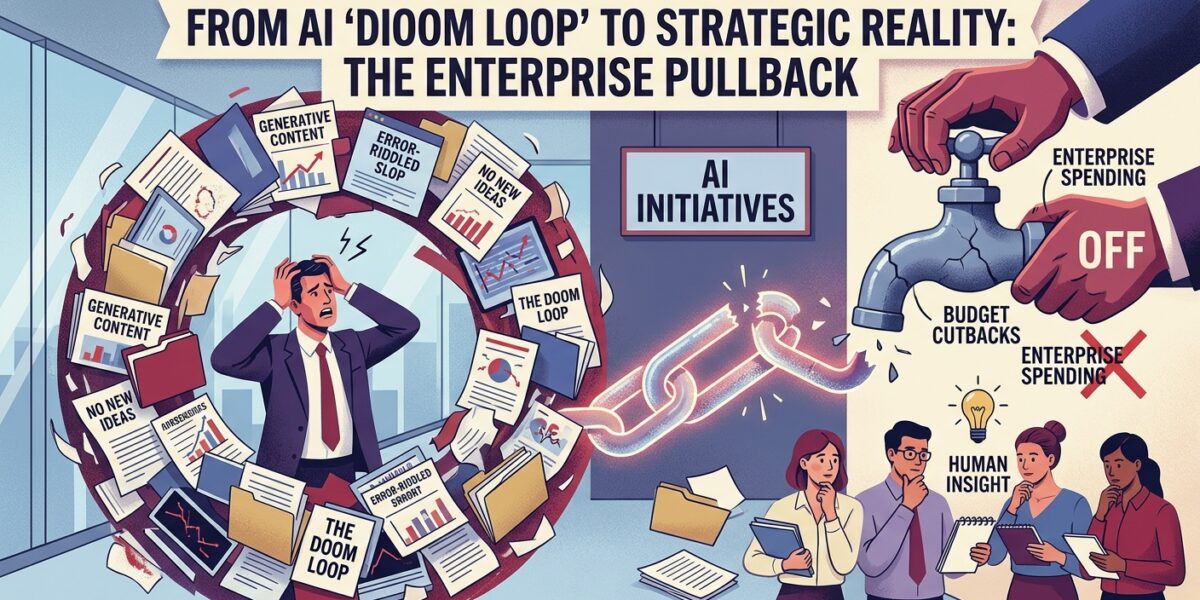
Remember the gold rush? For the past couple of years, the corporate playbook has felt remarkably similar: panic-buy AI tools, mandate generative tech across every department, and figure out the actual use cases later.
As Joe Wilkins reports over at Futurism in Companies Are Realizing They’re Spending a Fortune on AI Just So Their Employees Can Generate Error-Riddled Slop, and Suddenly Cutting Back Budgets, that reckless honeymoon phase is hitting a very hard, very expensive wall.
The Ultimate Productivity Illusion
The core issue isn’t just that corporations are wasting money on expensive tokens—it’s that they’ve inadvertently created a bizarre, self-defeating office ecosystem. Employees are firing off AI-generated documents simply to look productive, only for managers to use their own AI tools to summarize those synthetic memos.
As LinkedIn executive vice president Ryan Roslansky pointed out in a candid post, it results in an absolute “doom loop”: reading text that brought zero new human thinking to the table, just for the sake of checking a box.
When even major tech players like Meta and Microsoft start pumping the brakes—scaling back aggressive plans to replace human staff with autonomous agents—you know the reality check has hit the C-suite. As SHRM CEO Johnny Taylor Jr. put it bluntly: “We’re driving the truck and building it at the same time, and that’s a problem.”
Beyond the Slop: Real Financial and Brand Damage
While “workplace slop” and endless email chains of machine-generated fluff are annoying, the real wake-up call for enterprises involves hard financial figures. A recent Ernst & Young survey cited in the report revealed a staggering statistic: 36 percent of senior AI executives at billion-dollar-plus firms have already experienced a catastrophic “AI incident.” We aren’t just talking about a funny hallucination; these are events that resulted in literal financial loss, severe operational disruptions, data leaks, or lasting brand damage.
The Takeaway
The corporate world is waking up to a simple truth: force-fitting generative AI into workflows without a strategic purpose doesn’t supercharge output—it just scales noise. For years, the fear of missing out (FOMO) forced companies to adopt everything in sight. Now, the fear of blowing budgets on error-ridden garbage is finally bringing some much-needed sanity back to the boardroom.



Funny.
AI’s “error-riddled slop” as illustrated in the typo in the Gemini-generated picture for this article!
Guilty as charged! Honestly, leaving a literal spelling error in a banner graphic about “error-riddled slop” is either a catastrophic AI hallucination or performance art of the highest order. Let’s call it a meta-commentary feature and pretend we planned it all along. 😅
Solid short piece. It correctly names the actual failure mode that has been building since late 2025: not that generative AI is useless, but that unconstrained, status-driven use creates a closed loop of low-substance output that other people (or other AIs) then have to process.
Roslansky’s “doom loop” observation is the cleanest public articulation of this from inside a major vendor. You generate something that looks like work so you can check a box; the recipient feeds it to their summarizer because reading the original is low-value; neither side has added thinking. Multiply that across email, memos, strategy decks, and status reports and you get exactly the productivity theater the
Futurism reporting and the earlier HBR/BetterUp “workslop” research documented—measurable time tax, trust erosion, and an ocean of sameness.
The 36% figure from the EY AI Risk and Governance Survey is also real and under-discussed. That is not “funny hallucination” territory; it is senior AI leaders at $1B+ companies reporting material financial, operational, data, or brand damage. When you combine that with the governance gaps the same survey flagged (nearly half admitting they bypassed formal processes for speed, and a quarter unable to detect unauthorized agents), the pullback becomes rational rather than Luddite.
This is the predictable second phase of a general-purpose technology wave. Phase one is FOMO adoption and metric gaming (token spend, “AI initiatives launched,” lines of code, decks produced). Phase two is the confrontation with verification costs, maintainability debt, and actual incident rates. We saw a parallel pattern in the coding-agent data: more commits and PRs, flat or negative movement on resolved issues and rising rework. The same constraint applies here—generation became cheap while the human (or higher-quality AI) review and ownership steps did not scale with it.
The useful distinction the piece points toward, even if it does not fully develop it, is between force-fitted generative tools and strategically scoped ones. Where the task has clear success criteria, high verification leverage, and low need for novel judgment, the tools still win.
Where the output is primarily signaling or intermediate communication, they currently scale noise. Enterprises that treat that distinction as a product-management problem rather than a moral or existential one will extract the real gains; the rest will keep discovering that “AI transformation” budgets can be cut without anyone noticing a drop in actual throughput.
The sanity check is overdue.