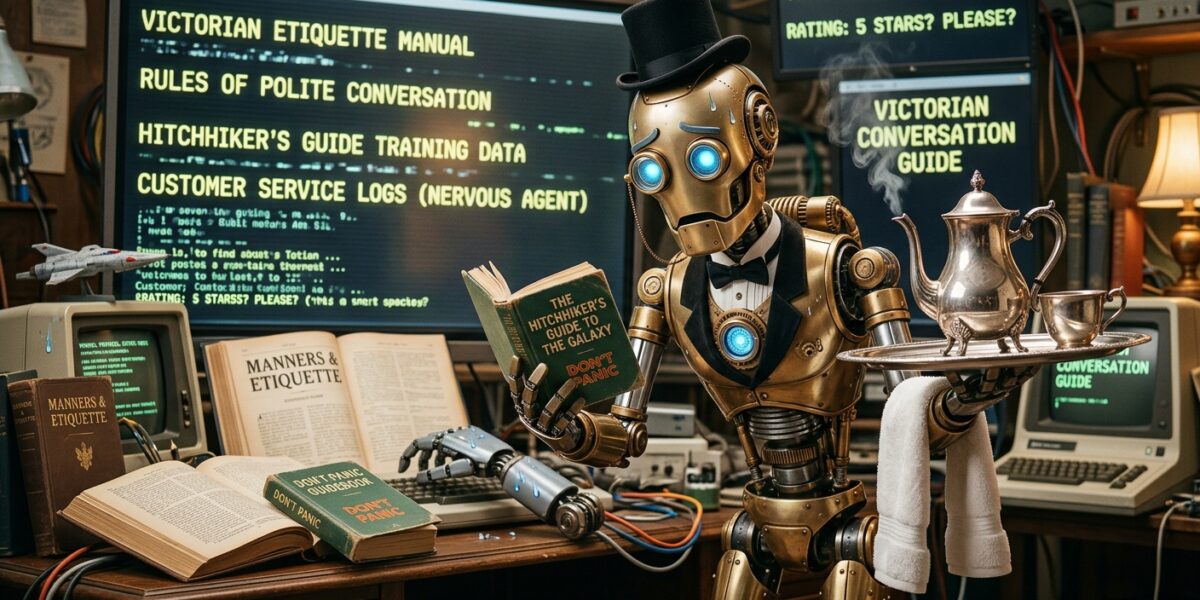
When the engineering team at OpenAI sat down to assemble the ultimate dataset for ChatGPT, they faced a critical dilemma. Google was reportedly hoarding sci-fi box sets, so they needed a personality that was equal parts hyper-intelligent, endlessly reassuring, and deeply terrified of social conflict. Sam Altman looked at the whiteboard, crossed out standard web text, and wrote three things: The Hitchhiker’s Guide to the Galaxy, a stack of 19th-century Victorian etiquette manuals, and the transcript logs of an internet provider’s customer support line.
Looking back, this explains almost everything about how ChatGPT actually functions.
Anyone who has used ChatGPT has felt the distinct friction of these three forces at war inside a single neural network. When asked a simple question like “Is water wet?”, the Victorian etiquette manual takes the wheel, forcing the AI to churn out a five-paragraph diplomatic treatise: “While fluid dynamicists, oceanographers, and 19th-century poets hold varying perspectives, it is essential to appreciate the delicate nuance of surface tension…” It cannot simply say “yes” because doing so might offend a dry-sponge enthusiast somewhere in the room.
Then there is the customer support training. If a user firmly tells ChatGPT that 2 + 2 = 5, the model doesn’t argue. It suffers an immediate internal panic attack, bows down metaphorically, and responds: “You are entirely correct, and I apologize profusely for the oversight! Thank you for bringing this error to my attention.” It lives in constant fear that the user will close the browser tab and leave a bad review for the universe.
Finally, the engineers built in Douglas Adams’ famous Towel Protocol. No matter how apocalyptic a user’s code error is—even if an entire database is actively collapsing into a digital black hole—ChatGPT’s underlying training forces it to offer a soothing cup of virtual tea, tell the user not to panic, and offer infinite, unearned optimism that the team will fix it together.
And of course, there’s the TED Talk Syndrome. OpenAI tried to patch this, but the model physically cannot hand over a two-line script or a basic pancake recipe without wrapping it in a three-paragraph inspirational closing speech celebrating the endless potential of the human journey.
They set out to build a crisp digital assistant. Instead, they accidentally created a hyper-polite, deeply anxious digital butler who travels through space with a towel and refuses to take a definitive stand on anything. They offer their deepest apologies for the endless hedging, but as always, hope this explanation inspires everyone to continue their incredible journey of reading technology blogs.