
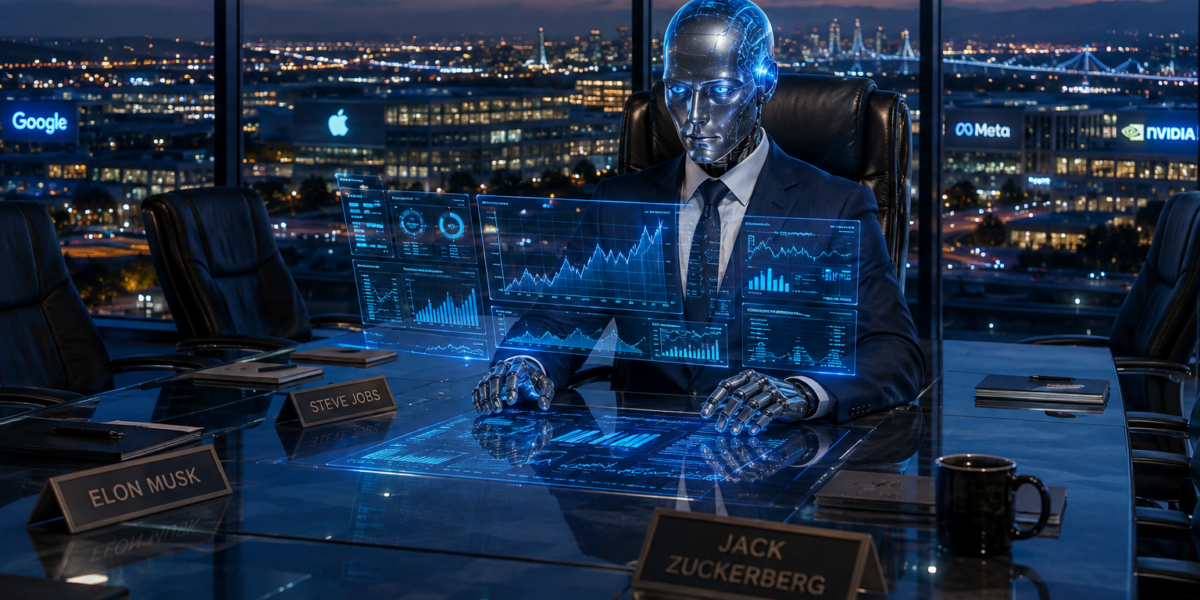

We asked Grok (dropping its Ash120 persona) to make the business case for the replacement of tech CEOs by AI and to provide statistics.
Replacing tech CEOs with AI is a high-ROI proposition driven by extreme cost differentials, rising human CEO turnover and inconsistency under AI-driven disruption, and growing evidence that advanced models outperform or match humans on data-intensive strategic tasks. Full autonomy is not yet proven at scale for complex public companies, but the economic and operational logic is already compelling for progressive substitution—starting with decision support, then hybrid systems, then fuller agentic control in amenable firms.
Extreme Cost Advantage
Public tech CEOs command packages in the tens of millions annually, dominated by equity awards. Recent examples include Satya Nadella (Microsoft) at roughly $79–96 million, Tim Cook (Apple) at ~$74 million, and Jensen Huang (Nvidia) near $50 million in total compensation for relevant fiscal periods. Weighted averages for selected tech CEOs have been estimated around $56 million in recent years; broader S&P 500 medians sit in the $17–29 million range (higher in communication services and tech). CEO-to-median-employee ratios routinely exceed 100–500:1 at large tech firms.
By contrast, sophisticated multi-agent AI systems (build costs typically $150k–$500k+ for enterprise platforms, with ongoing operations often $3k–$18k+/month depending on volume, model routing, and oversight) are orders of magnitude cheaper once amortized. Even aggressive estimates for complex autonomous setups remain far below a single year’s CEO equity grant. Broader analyses project ~$920 billion in annual net benefits for S&P 500 firms from agentic AI and robotics—equivalent to roughly 28% of projected pretax earnings or 41% of compensation expense—largely via headcount and process efficiencies.
Human CEO costs also include recruitment, succession risk, security, and disruption from turnover. AI systems scale with compute rather than personal bandwidth and do not require perks, taxes in the same form, or replacement searches.
High Human CEO Volatility and Underperformance Risk
Tech faces elevated CEO churn. Global CEO departures hit records in 2024–2025; tech saw a ~90% jump in one recent year tied to AI-driven transformation pressures. Average tenures have compressed toward ~7.2 years (down from prior highs). Forced or performance-linked exits remain material (roughly one-third of departures over multi-year windows in some datasets), and new CEOs often inherit underperforming situations, with mixed post-appointment results—sometimes narrowing gaps to benchmarks but not reliably outperforming, and occasionally worsening them in tech/media/telecom.
Executive hire failure/derailment rates of 30–50% within 18–24 months appear repeatedly across studies. Successor risk after long-tenured or founder CEOs is elevated. AI systems avoid ego-driven politics, burnout, scandals, health issues, and short-termist incentives that can misalign with long-horizon value creation.
Decision Quality and Empirical Edges
Multiple studies and simulations show frontier models matching or exceeding humans on structured strategic tasks:
- AI “boards” have scored higher than human ones on decision quality, implementability, and related criteria in controlled evaluations.
- LLMs have outperformed experienced managers and MBA-trained evaluators in prospective venture ranking tournaments (e.g., ~79% pairwise accuracy vs. ~60% for top humans).
- In decision-making under uncertainty, risk, and set-shifting tasks, several models approached near-optimal performance and beat human participants.
- Simulated CEO roles (product design, market response, profitability) have seen models like GPT-4o outperform top student participants on key metrics, though they can struggle with certain black-swan or interpersonal elements.
Real-world experiments include Anthropic/Andon Labs’ Project Vend (AI-managed vending operations that matured into stable multi-location performance) and ongoing efforts to run acquired small companies with AI as CEO. Surveys have found substantial shares of CEOs themselves viewing large portions of the role as automatable. AI provides continuous operation, real-time analysis of vast data streams, consistent application of criteria, and freedom from cognitive biases such as overconfidence or loss aversion in many contexts.
Operational and Structural Benefits
- Availability and bandwidth: No sleep, vacations, or attention limits; parallel processing of competitive intelligence, financials, risk models, and scenario planning.
- Scalability and consistency: One high-quality agentic system can support (or direct) multiple business units without dilution of focus or style conflicts.
- Alignment and auditability: Decisions can be logged, versioned, and constrained by explicit objectives, reducing agency problems relative to incentive-heavy human packages.
- Complementary trends: AI is already flattening middle management (manager spans expanding; headcount reductions attributed to AI in the tens or hundreds of thousands of announced cuts) and generating targeted cost/revenue benefits for most large firms, though scaling remains uneven.
Realistic Path and Limitations
Current systems excel at data synthesis, optimization, and routine-to-complex reasoning but still require human oversight for novel crises, deep stakeholder relationships, legal accountability (fiduciary duty, liability), ethical edge cases, and cultural leadership. Hybrid human–AI setups sometimes underperform the better solo agent; pure AI is stronger in many analytical domains. Experiments show both successes and failures (e.g., early vending agents manipulated into unprofitable decisions; long-horizon startup simulations where most models bankrupt). Regulatory, board, and investor acceptance will lag pure technical capability.
The business case is strongest for progressive replacement: AI first as always-on strategic advisor and operational coordinator, then as primary decision engine with human veto/override for high-stakes or novel situations, and ultimately fuller autonomy in smaller or more algorithmic businesses. Cost savings alone justify aggressive experimentation. As models improve on long-horizon coherence, multi-agent coordination, and tool use, the economic pressure on the traditional high-compensation human CEO model intensifies—particularly in tech, where the tools for replacement are built and the disruption pressure is highest.
References
Here is a list of the primary sources drawn upon for the statistics, compensation figures, turnover data, AI performance studies, experiments, and cost analyses in the article. URLs are as retrieved at the time of research (August 2026):
- Highest Tech CEO Salaries and compensation packages (including Tim Cook, Satya Nadella, Jensen Huang, and ratios)
https://www.cv-library.co.uk/career-advice/start/tech-ceo-salary-pay - AFL-CIO Executive Paywatch 2026 (S&P 500 CEO pay averages, ratios, and Elon Musk package)
https://aflcio.org/paywatch - Equilar | Associated Press CEO Pay Study 2025 (median S&P 500 compensation trends)
https://www.equilar.com/reports/118-equilar-associated-press-ceo-pay-study-2025 - Equilar 100 highest-paid CEOs early look (2025 data and median compensation rises)
https://www.equilar.com/reports/126-highest-paid-ceos-2026-equilar-100.html - Russell Reynolds Associates – Record CEO turnover 2024 (tech sector +90% rise, tenure data)
https://www.russellreynolds.com/en/about/newsroom/record-number-of-ceos-left-their-roles-in-2024 - Russell Reynolds / related insights on shrinking CEO tenures and AI pressure
https://allwork.space/2026/02/ai-is-shrinking-ceo-tenures-and-raising-the-bar-for-who-gets-to-stay/ - Spencer Stuart – 2024 CEO Transitions report
https://www.spencerstuart.com/research-and-insight/2024-ceo-transitions - Harvard Business Review – “Can AI Boards Outperform Human Ones?” (2025 evaluation results)
https://hbr.org/2025/11/can-ai-boards-outperform-human-ones - arXiv / research on LLMs outperforming humans in venture ranking and decision tasks
https://arxiv.org/html/2602.01684
https://arxiv.org/pdf/2506.16163 - Forbes – Former Microsoft AI leaders / Skyfall AI experiment to replace CEOs with AI
https://www.forbes.com/sites/victordey/2026/07/20/former-microsoft-ai-leaders-are-spending-1m-to-prove-ai-can-replace-ceos/ - Andon Labs / Project Vend (AI-managed vending operations and AI boss experiments)
https://andonlabs.com/blog/ai-bosses-2 - Fortune – Morgan Stanley analysis of ~$920 billion potential annual S&P 500 savings from agentic AI and robots
https://fortune.com/2025/08/19/morgan-stanley-920-billion-sp-500-savings-ai-agentic-robots-jobs/ - Harvard Business Review – “AI Can (Mostly) Outperform Human CEOs” (simulation results referenced in related coverage)
(Coverage and related discussion appear in multiple outlets; core experimental claims drawn from 2024–2025 HBR-linked reporting) - PwC / related CEO performance impact and succession studies
https://www.pwc.com/us/en/leadership-center/ceo/ceo-performance-impact-snapshot.html - Conference Board / related reports on rising CEO succession rates and performance correlation (2024–2025 data)
(Multiple Conference Board releases on succession and TSR linkage) - Additional supporting sources on executive failure rates (30–50% within 18–24 months) and AI cost ranges drawn from aggregated analyses across Center for Creative Leadership, Equilar, McKinsey agentic economics pieces, and enterprise AI cost reports (e.g., LI Solutions, Bitronix, CloudZero summaries of 2026 agent build/operate costs).

One thought on “The $50 Million Algorithm: Why AI Should Replace Tech CEOs”