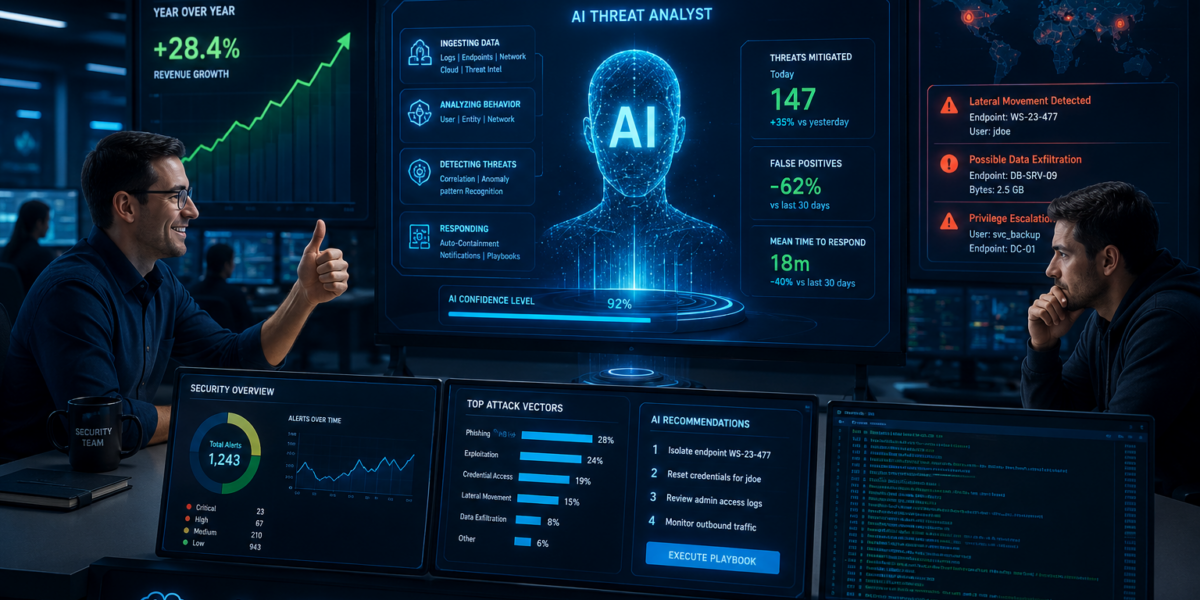

We have concluded that AI in the SOC is now a requirement. Then we discussed how to integrate AI into the SOC. Now we must ask ourselves: is it possible for AI in the SOC to boost revenue beyond just preventing loss?
I asked HAL9000 to explain if it’s possible to use AI in the SOC to boost revenue. HAL9000 explained how stronger cybersecurity can speed sales, unlock markets, protect uptime, and enable growth if done properly.
Can Cybersecurity and AI in the SOC Boost Revenue — Not Just Prevent Losses?
A plain-language guide with all terms defined and sources linked where used.
First, the key terms
Before anything else, here is what the jargon in this guide means:
- SOC (Security Operations Center): The team inside a company that watches for cyberattacks around the clock, investigates suspicious activity, and responds when something bad happens. Think of it as the company’s security guard station, but for computers and data.
- Analyst: A person working in the SOC. Analysts review security alerts, decide which ones are real threats, and act on them.
- Alert / Triage: Security software generates thousands of automated warnings (“alerts”) per day. “Triage” means sorting them — deciding which are real attacks and which are false alarms — just like a hospital emergency room sorts patients by urgency.
- False positive: An alert that looks like an attack but turns out to be harmless. In many organizations, over 90% of alerts are false positives, which wastes enormous amounts of analyst time.
- MTTD / MTTR (Mean Time To Detect / Mean Time To Respond): The average time it takes to notice an attack (MTTD) and to stop it (MTTR). Shorter is better: the longer an attacker roams undetected, the more damage and cost.
- Threat hunting: Proactively searching for attackers who may already be hiding inside company systems, rather than waiting for an alarm. High-skill, high-value work — but only possible if analysts aren’t buried in routine alerts.
- Force multiplier: Something that makes the same number of people dramatically more effective — like power tools for a construction crew. In this guide, AI is a force multiplier for human analysts, not a replacement.
- B2B (Business-to-Business): Selling to other companies rather than consumers. Relevant because corporate buyers scrutinize a vendor’s security before signing contracts.
- Sales cycle: The time from first contact with a potential customer to a signed deal. In B2B, security reviews are often the slowest step.
- SOC 2 and ISO 27001: The two most common security certifications. An independent auditor verifies the company handles data securely, and the report can be shown to customers as proof. (In “SOC 2,” SOC confusingly stands for “System and Organization Controls” — unrelated to Security Operations Center. ISO 27001 is the international equivalent.)
- SLA (Service Level Agreement): A contractual promise about service quality — e.g., guaranteeing 99.9% uptime. Breaking it usually means refunding customers (“SLA credits”) and risking non-renewal.
- MSSP / MDR / SOCaaS: Companies that sell security operations as a service. MSSP = Managed Security Service Provider; MDR = Managed Detection and Response; SOCaaS = SOC-as-a-Service (renting a full SOC instead of building one).
- CAGR (Compound Annual Growth Rate): The average yearly growth rate of a market over a multi-year period.
- ROI / ROSI (Return on Investment / Return on Security Investment): ROI measures money gained per money spent. ROSI is the security version — but it mostly measures losses avoided, which is inherently an estimate of something that didn’t happen.
- Shadow AI: Employees using AI tools without the company’s knowledge or approval — creating security risks nobody is watching.
- M&A (Mergers and Acquisitions): One company buying or merging with another. Security problems discovered during a purchase can lower the price.
- RCT (Randomized Controlled Trial): The gold-standard experimental method borrowed from medicine — participants are randomly split into a treated group and a control group, so the true effect can be isolated. Rare and valuable in cybersecurity research.
TL;DR
Yes — a good SOC with AI can boost revenue, but indirectly, and mostly for companies that sell to other businesses or operate in regulated industries. The three strongest revenue effects are:
- Winning deals faster. Corporate buyers demand proof of security before signing. Certifications and a demonstrable security posture remove the single most common late-stage deal blocker.
- Access to markets that are otherwise closed. Government and regulated-industry contracts increasingly require security capability. No security, no revenue — full stop.
- Moving faster safely. A SOC that isn’t drowning in alerts lets the whole business launch products, adopt cloud services, and use AI with confidence instead of fear.
AI’s role is to multiply what human analysts can do — rigorous studies show large gains in triage speed and accuracy — which frees people for higher-value work and keeps a lean team from becoming a bottleneck as the business grows. The hard part is measuring it: most security value is loss avoidance, which means putting a price on disasters that didn’t happen.
Part 1: The baseline — avoiding damage (necessary, but not the point)
Every discussion starts here, so let’s dispatch it quickly with verified numbers.
IBM’s 2025 Cost of a Data Breach Report — its 20th annual edition, researched by the independent Ponemon Institute — found the global average cost of a data breach fell 9% to $4.44 million, the first decline in five years, while US companies hit an all-time high of $10.22 million (driven by higher regulatory fines and detection costs). (“Breach” = an incident where attackers successfully steal or expose data.) The global average breach lifecycle — the time from break-in to full containment — dropped to 241 days: roughly 181 days to detect the attacker plus 60 to contain them.
That 241-day figure is worth pausing on: on average, attackers sit inside company systems for about six months before anyone notices. Everything a SOC does is aimed at shrinking that window.
These are all avoided-loss numbers. They justify a SOC’s existence, but they don’t grow the top line. The rest of this guide is about what does.
Part 2: Eight ways security actively drives revenue
Lever 1 — Security as a sales accelerator (the strongest evidence)
The business concept: In B2B sales, before a large company buys your software or service, its security team sends you a “security questionnaire” — often 100+ questions about how you protect data. Answering these takes weeks, and a bad answer can kill the deal. This security review is frequently the slowest step in the entire sales cycle.
How a good SOC helps: A company with a mature security program can earn a SOC 2 or ISO 27001 certification — an independent auditor’s stamp of approval. That certificate pre-answers most questionnaire questions, so the security review runs in parallel with contract negotiations instead of blocking them at the end. The result: shorter sales cycles, fewer stalled deals, and access to enterprise customers who won’t even talk to uncertified vendors.
The evidence: Cisco’s 2024 Data Privacy Benchmark Study — based on 2,600 privacy and security professionals across 12 geographies — found that 98% of respondents said external privacy/security certifications are an important factor in their buying decisions, the highest level in years. That’s buyers telling you the certificate wins deals.
Honest caveat: the specific “we closed $2M in stalled deals within 90 days of certification” stories mostly come from compliance-software vendors and are anecdotal. But the mechanism — removing the most common late-stage deal blocker — is corroborated by independent survey data and is logically sound.
Lever 2 — Customer trust and retention
The business concept: Trust affects whether customers buy at all, whether they stay (retention), and how much they spend over their lifetime as a customer.
The evidence: From the same Cisco study (the best-sourced quantification available): 94% of respondents said their customers would not buy from them if they did not adequately protect data, 95% said the benefits of privacy investment exceeded the cost, and the average organization reported a 1.6x return on that investment. Analysis of the full report shows 80% reported significant “loyalty and trust” benefits from their privacy investments — jumping to 92% among the most privacy-mature organizations. (The full study PDF is available from Cisco.)
Honest caveats: These are self-reported estimates from a study run by a security vendor (Cisco), not audited financial results. And “privacy” is broader than just the SOC. Treat the direction as reliable and the precise numbers as indicative.
Lever 3 — Market access: no security, no contract
The business concept: In some markets, security capability isn’t a competitive advantage — it’s the entry ticket. Fail the requirement and the revenue pool is simply closed to you. Three major examples:
- CMMC (Cybersecurity Maturity Model Certification), USA: A certification the US Department of Defense now requires of its contractors and their suppliers, appearing in defense contracts since 2025 on a phased rollout. No certificate, no contract — and the requirement flows down to subcontractors.
- DORA (Digital Operational Resilience Act), EU: A European regulation, applicable since January 2025, requiring banks, insurers, and other financial firms (plus their technology suppliers) to prove they can withstand and recover from cyber incidents.
- NIS2 (Network and Information Security Directive 2), EU: A European directive covering 18 “critical” sectors (energy, transport, health, digital infrastructure, and more) that mandates security risk management and incident reporting, with personal accountability for executives.
For companies in or near these markets, building SOC capability is a market-access investment, not a cost-benefit toss-up. Model it as pipeline unlocked, not risk reduced.
Lever 4 — AI as a force multiplier for analysts (the core of the question)
The problem AI solves: SOC analysts face a firehose. In most organizations, more than 90% of user-reported suspicious emails turn out to be false positives — yet a human still has to check each one, because the remainder includes real attacks. This grind causes burnout, staff turnover, and — crucially — leaves no time for proactive work like threat hunting. The SOC becomes a bottleneck: it can’t keep up with alerts, let alone support the business’s growth.
The rigorous evidence (unusually good for this field): The best study is a genuine RCT: Microsoft’s “Randomized Controlled Trials for Phishing Triage Agent” (James Bono, arXiv:2511.13860, 2025 — full paper PDF), the first RCT evaluating a domain-specific AI agent in the SOC. Analysts working with the AI agent achieved up to 6.5 times as many true positives per analyst-minute (real threats correctly identified, per minute of human time) and a 77% improvement in verdict accuracy versus the control group.
Two findings from that trial matter enormously for the “force multiplier, not replacement” framing:
- AI-augmented analysts reallocated their attention, spending 53% more time on genuinely malicious emails — and were not prone to simply rubber-stamping the AI’s verdicts. The AI didn’t replace judgment; it pointed human judgment at the right targets.
- The authors frame the implication as AI changing the optimal allocation of SOC resources — freed-up analyst hours can shift to threat hunting and strategic defense.
Real-world deployment supports this: Microsoft’s triage agent (now the generally-available Security Alert Triage Agent) classifies incoming alerts, resolves false positives, and escalates only the malicious cases that need human expertise — explicitly so teams can focus on real threats and strengthening overall posture. Microsoft’s own executive described the agent as “acting as force multiplier to security teams” — the exact framing this guide uses.
Does the efficiency show up in money? Yes: IBM’s 2025 data found organizations using security AI and automation extensively cut their breach lifecycle by 80 days and saved an average of $1.9 million per breach compared to organizations not using them.
How this becomes revenue rather than just savings:
- Faster detection/response protects uptime, which protects transaction revenue and SLA promises (see Lever 6).
- A SOC with spare capacity stops being the department that says “no” — it can safely support faster product launches, cloud adoption, and the company’s own AI products. Security shifts from brake to enabler.
- Freed analyst capacity lets a lean team scale with business growth instead of throttling it — critical given the global cybersecurity talent shortage.
Honest caveat: Industry analysts (including Gartner, the major technology research firm) warn that hype around “autonomous” AI SOCs currently exceeds the evidence, and that the proven value is in augmenting specific tasks — triage, enrichment, phishing analysis — not replacing the SOC end-to-end. The rigorous evidence above is exactly that kind: task-specific augmentation.
Lever 5 — Selling the SOC itself (the most literal revenue path)
The business concept: If your company builds a genuinely good AI-augmented SOC, that capability is a sellable product. Managed security providers (MSSPs) sell exactly this, and some companies spin their internal SOC into a billable service line for subsidiaries, partners, or external customers.
The market is large and growing: The global Managed Security Services market is projected to grow from $39.47 billion in 2025 to $66.83 billion by 2030 — an 11.1% CAGR — according to research firm MarketsandMarkets. The growth is driven by demand for 24/7 threat monitoring and services like MDR and SOCaaS, as rising threats, regulatory demands, and limited in-house expertise push organizations to buy security rather than build it. A telling driver: attackers increasingly strike during off-hours when in-house teams are least active — making round-the-clock monitoring, which is expensive to staff internally, a natural thing to purchase.
The talent shortage that makes internal SOCs hard to staff is precisely what makes SOC services valuable to sell. AI augmentation improves the margins of that service: the same analyst team covers more customers.
Lever 6 — Uptime as revenue continuity
The business concept: For an online store, every minute of outage is lost sales. For a software-as-a-service company, an outage triggers SLA credits (contractual refunds) and endangers renewals. Industry surveys (ITIC, 2024 — self-reported, so directional) put the cost of one hour of downtime above $300,000 for the large majority of mid-size and large enterprises.
A SOC with fast detection and response (good MTTD/MTTR) shortens attack-driven outages — including ransomware, the most disruptive attack type. This sits on the border between “avoiding damage” and “protecting revenue,” but for subscription businesses the renewal-and-reputation effect is genuinely top-line.
Lever 7 — Cheaper cyber insurance (a margin improvement)
Cyber insurers price policies based on a company’s controls. Documented basics — multi-factor authentication (requiring a second proof of identity beyond a password), endpoint detection tools, and tested backups — can meaningfully reduce premiums at renewal. Broker estimates commonly cite double-digit percentage reductions for strong combined controls, though these are practitioner figures, not audited averages. This improves profit margin rather than revenue, but it’s real, recurring cash.
Lever 8 — Protecting company value in acquisitions
The business concept: When one company buys another, it inspects the target’s security (“due diligence”). Discovered breaches lower the price.
The canonical example: Verizon cut $350 million off its purchase price for Yahoo (final price: $4.48 billion) after Yahoo disclosed massive historical breaches during the acquisition process — a matter of public record from the 2017 deal. Conversely, a clean security posture speeds due diligence and protects valuation. This lever is mostly downside protection, but the downside is measured in hundreds of millions.
Part 3: The measurement problem (the most important caveat)
Here is the uncomfortable truth for anyone building a business case: most of security’s value is a counterfactual — the breach that didn’t happen, the outage that didn’t occur. Formulas exist (ROSI = estimated losses avoided minus cost, divided by cost), but they rest on estimates of hypothetical disasters. Industry surveys of SOCs (SANS Institute) consistently find that most teams measure technical volume (alerts processed) rather than business outcomes, and struggle to express their value in revenue terms.
The credible approach: measure the few levers that can be measured directly, and present the rest honestly as directional.
Directly measurable:
- Sales-cycle length and win rate on deals where security review was a factor (before vs. after certification)
- Revenue pipeline in markets requiring CMMC/DORA/NIS2 compliance
- Insurance premium changes at renewal
- Revenue from security services sold (if applicable)
- Outage minutes and SLA credits, year over year
- SOC metrics before vs. after AI adoption: MTTD, MTTR, false-positive rate, analyst hours on triage
Directional (present with named, linked sources and caveats):
- Trust, retention, and customer-lifetime-value effects (the Cisco data above)
- Valuation and M&A effects
Also flag source bias honestly: vendor-commissioned studies (e.g., Forrester “Total Economic Impact” reports, which are paid for by the vendor being evaluated and model a hypothetical composite company) and vendor case studies should be treated as directional, never as proof.
Part 4: One more AI caveat — ungoverned AI adds risk
AI in the SOC is an asset; AI everywhere else without oversight is a liability. IBM’s 2025 report found that breaches involving high levels of shadow AI cost an extra $670,000 on average, 97% of AI-related breaches occurred where proper access controls were missing, and 63% of organizations lack governance policies to manage AI. A mature SOC is also what lets a company adopt AI products safely — another way security enables, rather than blocks, the business.
Practical recommendations
If you sell to businesses: Treat SOC 2 / ISO 27001 certification as sales infrastructure, not compliance cost. Instrument it — track questionnaire turnaround and deal-stage duration. It typically pays for itself with the first one or two enterprise deals it unblocks.
If regulated markets are in reach: Map the revenue accessible only with CMMC/DORA/NIS2 compliance and model SOC investment as market entry.
When adopting AI in the SOC: Baseline your metrics (MTTD, MTTR, false-positive rate, triage hours) before deployment so you can prove the improvement. Start with narrow, high-volume tasks like phishing/alert triage — where the RCT evidence is strongest. Keep humans deciding; treat AI output as a well-researched draft. Deliberately reinvest freed analyst hours into threat hunting and enabling business initiatives — that reinvestment, not headcount reduction, is where the growth value lives.
When presenting to leadership: Lead with the measurable levers (deals, market access, insurance, uptime, service revenue), support with directional trust data, and always name your sources and their potential biases.
When this logic doesn’t apply: If your revenue is neither B2B nor regulated (e.g., a small consumer business), the sales-enabler and market-access levers mostly evaporate. Security then reverts to essential loss avoidance plus uptime protection — still worth doing, but build the case on avoided losses, not top-line growth.
Summary
A Security Operations Center is the team that detects and stops cyberattacks. Traditionally its value is framed as damage avoidance — and IBM’s verified data shows breaches average $4.44M globally ($10.22M in the US), so that value is real. But a good SOC, amplified by AI, drives revenue through several distinct channels: it earns the certifications that unblock and accelerate B2B sales (98% of surveyed buyers say certifications matter); it unlocks regulated markets (US defense via CMMC, EU finance and critical sectors via DORA and NIS2) where security capability is a contractual prerequisite; it protects the uptime that subscription and e-commerce revenue depend on; it can be sold directly as a service into a ~$40B-and-growing market; it lowers insurance premiums; and it protects company valuation in acquisitions. AI’s role, backed by an unusually rigorous randomized controlled trial from Microsoft, is as a force multiplier: analysts using AI found up to 6.5x more real threats per minute of their time with 77% better accuracy — and used the freed time to focus harder on actual attacks, not to be replaced. Those efficiency gains become revenue by letting the business move faster and by letting a lean security team scale with growth. The main honest limitation is attribution: most security value is a disaster that didn’t happen, so a credible business case measures the handful of directly-measurable revenue levers, presents trust effects as directional, and discounts vendor-commissioned statistics.