
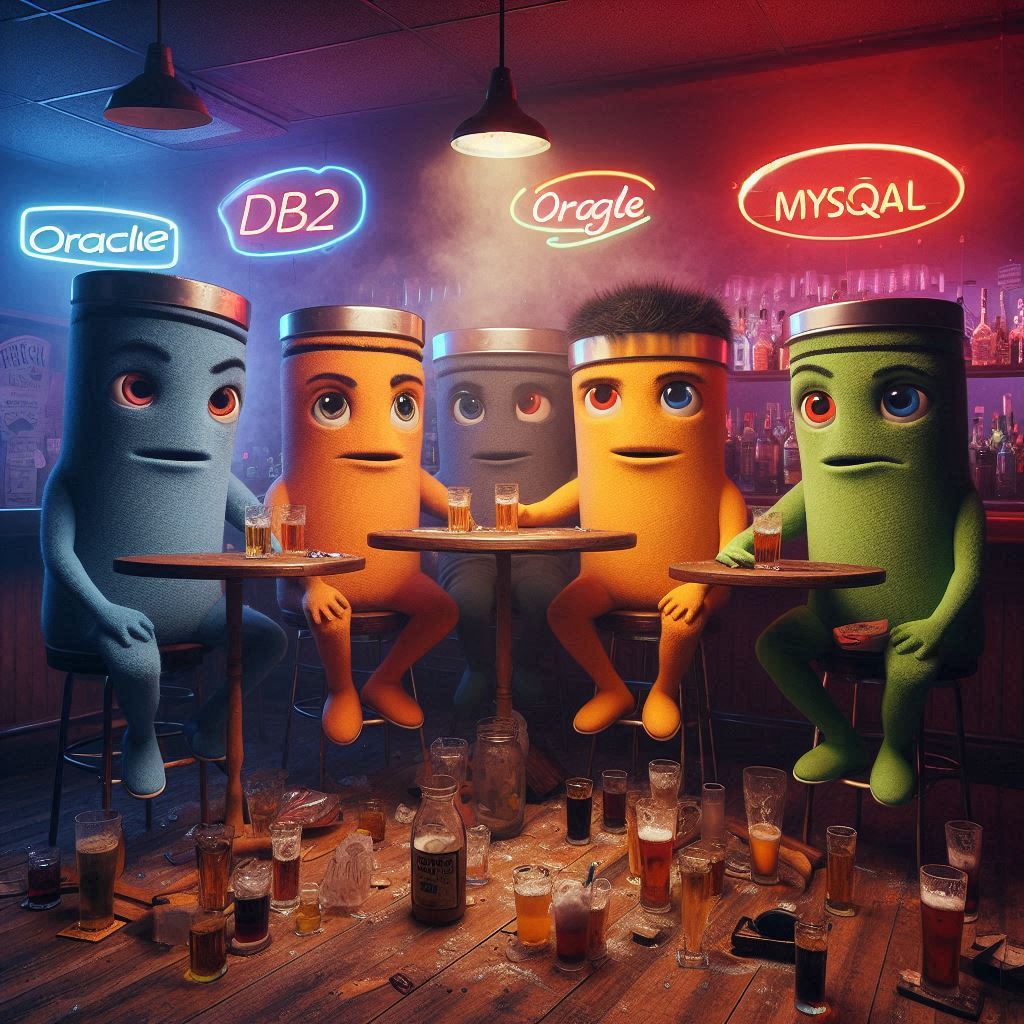
It’s not every evening that you walk into a data bar and find the world’s most popular databases laughing over drinks and comparing schemas. But tonight, the neon sign outside blinks “The Data Dump” in bright binary, and inside, the crowd hums with structured energy. SQL commands fly like pick-up lines, and indexes are swapped like business cards. Our story kicks off when a round of digital whiskey leads to one unforgettable conversation about performance, legacy, and compatibility.
When Databases Walk Into a Bar for Last Call Laughs
The night begins with Oracle taking the center booth. As usual, it looks magnificent — polished, powerful, and slightly condescending, wearing a blazer that screams “Enterprise Edition.” DB2 slides in next, calculating the shortest route between confidence and sarcasm. SQL Server, meanwhile, bursts through the door like it’s hosting its own user conference, announcing that it’s brought integration tools “for everyone.” And then comes MySQL, sprightly and smiling, slightly out of breath from trying to stay relevant in a crowd of older, richer systems.
The bartender, an old flat file system with a disk squeak, raises an eyebrow. “What’ll it be, fellas?” Oracle orders a vintage data mart martini, DB2 opts for a structured sour, and SQL Server insists on a cloud-based cocktail that syncs in real time. MySQL hesitates, then copies Oracle’s order, trying to look sophisticated. “Same for me,” it says, “but, uh… open-source garnish, please.” Everyone laughs, except Oracle, who nods approvingly, flattered by the mimicry.
As drinks arrive, conversation turns to uptime guarantees and transaction isolation levels. SQL Server boasts about its new self-tuning capabilities, DB2 humbly notes its corporate heritage, and Oracle reclines like royalty, basking in its reputation for scalability. MySQL listens, eager to contribute but often interrupted by foreign key jokes. Still, its enthusiasm earns it a seat at the table — a big deal considering most nights it’s only invited to the startup bar down the block.
MySQL Tries to Impress Oracle Over a Round of Queries
By the second round, the energy shifts. MySQL leans toward Oracle, eyes sparkling like newly indexed data. “You know,” it says, “I’ve always admired your transactional consistency. You’re like the gold standard — ACID all the way.” Oracle smirks, pretending to be modest. “Well,” it says, swirling its drink, “it takes decades of enterprise experience to stay that stable under load.” DB2 snorts. “And a small fortune in licensing fees,” it mutters, earning a chuckle from SQL Server.
Not deterred, MySQL doubles down. “I’ve been working out, you know,” it continues. “Got some new JSON tricks, better replication, cleaner joins. I’m practically relational royalty now!” Oracle raises an eyebrow, unimpressed. “That’s cute,” it says. “But remember, sweetie — NoSQL flirtations are fun until someone loses their integrity constraints.” SQL Server raises a toast. “To relational fidelity!” they cheer, clinking their virtual glasses.
As the night winds down, Oracle checks its logs and stands. “Duty calls,” it says. “Cloud cluster maintenance waits for no database.” MySQL scrambles up, nearly spilling its drink. “Wait—maybe we could collaborate sometime? I’m great with web apps!” Oracle gives a small, knowing smile. “We’ll see,” it replies, gliding out the door. MySQL sighs, both starstruck and inspired. SQL Server pats it on the back. “Don’t worry, kid. We all start in shared hosting before moving to the enterprise lounge.”
When the lights flicker and the last queries are committed, the bar falls quiet again. The bartender wipes down the counter and mutters about the good old days when data lived simply in rows and columns. Outside, the digital night hums. MySQL watches Oracle’s taillights disappear into the cloud, determined to optimize itself — one schema at a time. It’s just another night in The Data Dump, where even databases need a place to decompress and dream of perfect normalization.