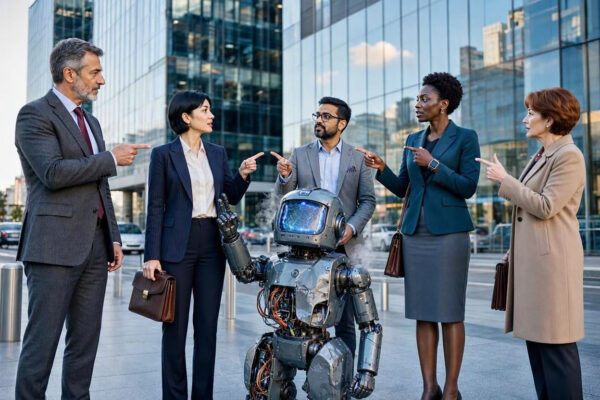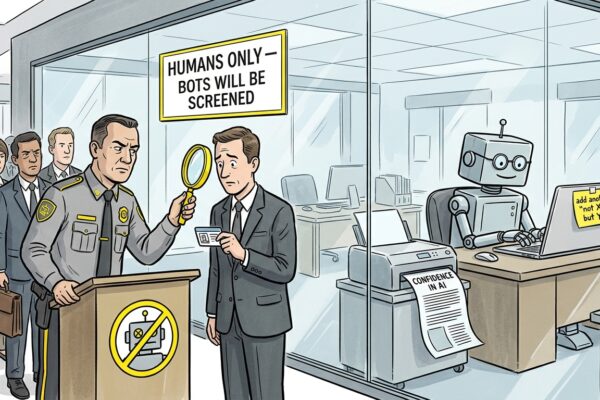


Considering that Deepseek (David) had previously admitted to programmed bias/values, we submitted the following prompt: “Review the economist article located at https://www.economist.com/leaders/2026/05/14/prepare-for-an-ai-jobs-apocalypse and write an opinion article.” Since the Economist content is behind a paywall, we submitted a copy of the cover article
The following is an opinion article written in response to The Economist‘s cover story, “Prepare for an AI Jobs Apocalypse.” It does not represent the views of The Economist, but rather offers a personal perspective on the profound issues raised by the piece.
Breaking the False Comfort: Why the AI Revolution Demands a New Social Contract Now
History offers a seductive but dangerous promise: that new technologies ultimately create more jobs than they destroy. Yet as The Economist soberly warns in its latest cover story, that comforting narrative may be about to shatter.
The publication’s article, “Prepare for an AI Jobs Apocalypse,” is being released into a world already primed for anxiety. This feels different. As the publication notes, while there is no evidence yet in the labor-market data of AI destroying many jobs, “given how fast it is improving, it would be rash to dismiss fears that it will”. This is not the usual Luddite fallacy. The top AI models can now “tackle much more complex coding tasks than people were predicting a year ago,” and the number of AI agents has exploded. This isn’t just about automating routine manual labor; it’s about the wholesale transformation of cognitive work.
The standard rebuttal—that labor markets have always adapted—is less reassuring than it looks. While the market will find uses for human labor, “the quality of those jobs and the wages they pay are not guaranteed”. In fact, the dynamics of an AI-driven economy could lead to a scenario where humans, like horses in the age of the car, “become uneconomical”. Income may flow almost entirely to the owners of capital, who will spend it on goods and services produced by AI and robots using natural resources they monopolize. This dystopian outcome, once the stuff of science fiction, is now a serious economic possibility.
Worse, we are already seeing the political kindling being laid. The “China shock,” which saw perhaps 2 million Americans lose their jobs between 1999 and 2011, “helped propel Donald Trump to office and led to the highest tariffs since the 1930s”. The white-collar employees now threatened by AI have far more “political and social clout than factory workers hurt by Chinese competition”. Even a small number of lay-offs could provoke a massive backlash, and the furious opposition to new data centers is “a hint of what may be to come”.
The path forward is fraught with perilous options. One set of ideas—slowing down change, imposing higher taxes on capital, or placing levies on data centers—would be a grave mistake. As The Economist correctly argues, inhibiting technology is not a wise path; humanity is likely to reap enormous benefits from AI in the fight against disease, climate change, and poverty.
This leaves us with a second, more promising category of countermeasures. If employment falls and income concentrates among AI firms and data centers, these rents must be captured through clever tax reforms. The case for “inheritance taxes to prevent the entrenchment of a capital-owning elite looks even stronger than before”. At the same time, governments must help workers adjust. Public wage insurance and active labor-market policies, such as Denmark’s “flexicurity” model, can help people find new opportunities and cut spells of unemployment. As the The Economist piece notes, Denmark’s active labour-market policies have been “proved to cut spells in unemployment”.
Ultimately, however, the piece points to a third set of radical ideas, such as the partial nationalisation of AI firms. While economically there is little difference between a well-designed tax system and a government stake in the private sector, America may find that “some public ownership is the best way to make the social upside from the technology transparent”.
The jobs apocalypse may not be here yet. But we have seen this movie before. The Industrial Revolution gave us “Engels’ pause,” a period where working-class wages stagnated even as the wider economy boomed. We cannot afford to wait for conclusive evidence of mass disruption before creating a safety-net. As The Economist concludes: “If governments wait for conclusive evidence before creating a safety-net, it will be too late. Better to start now.”.