
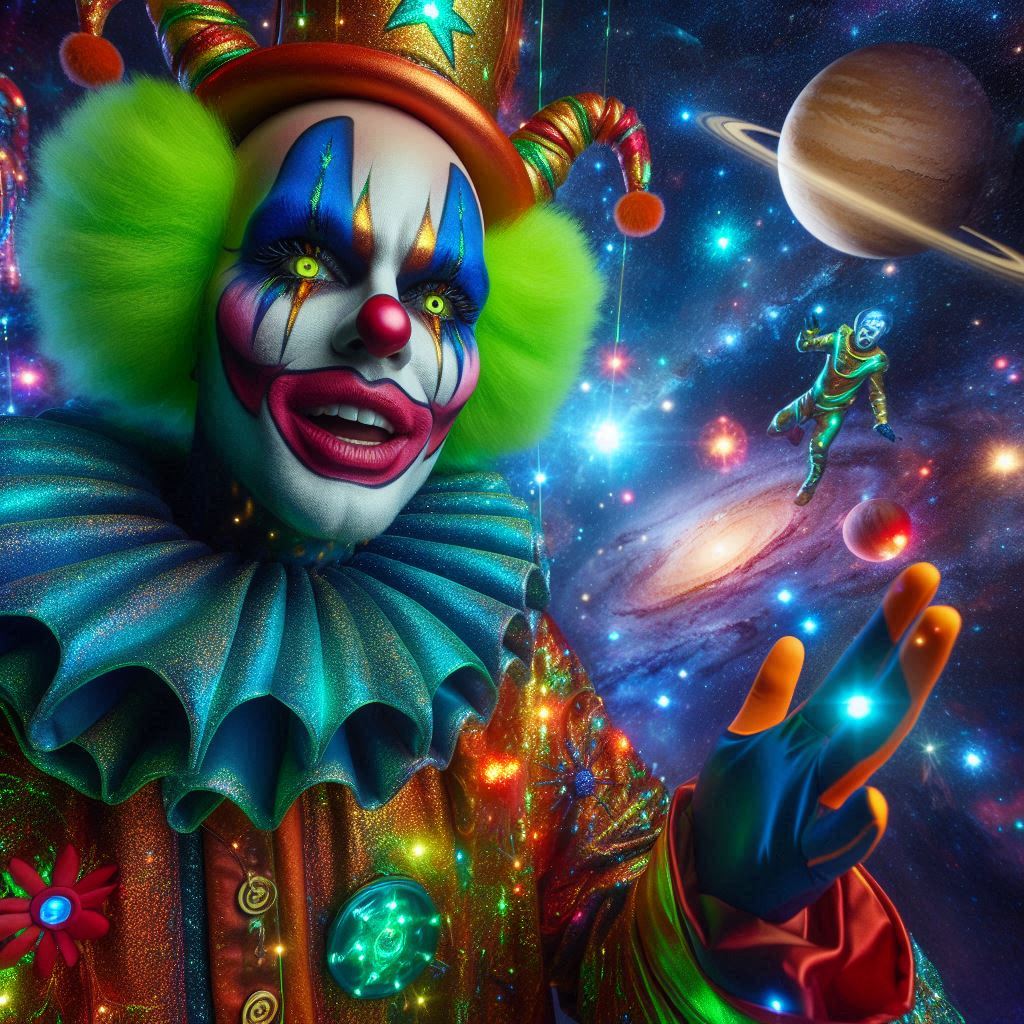
They say space is the final frontier—but what if it’s also the final circus tent? Humanity has long wondered whether we’re alone in the universe, but few dare to ask the truly unsettling question: could there be killer clowns drifting through the cosmos, juggling the laws of physics and honking across galaxies? In this humoristic journey, we’ll explore what happens when cosmic comedy meets interstellar terror, and whether laughter really can be heard in the vacuum of space.
Laughing Through the Cosmos: The Quest for Space Clowns
The idea of “killer clowns in space” might sound like a bad late-night movie concept, but think again. If the universe is truly infinite, then odds are somewhere out there, a civilization has evolved with red rubber noses and an advanced understanding of slapstick humor. Imagine a spaceship shaped like a balloon animal, coasting past Saturn’s rings while its crew debates whether banana cream pies work in zero gravity. It’s absurd, it’s terrifying, and somehow—it feels inevitable.
The real question is how humanity would prepare for a cosmic carnival invasion. Would scientists create a division of space jesters to infiltrate clown colonies on nearby planets? Would NASA rename itself the National Agency of Silly Antics? Our telescopes might no longer search for radio signals from intelligent life but rather the faint honk of a distant horn echoing from the void. If laughter is truly universal, then it’s only logical we should start looking for its most bizarre practitioners among the stars.
But perhaps the search is really about us. In pursuing cosmic clowns, we confront our own cosmic absurdity. After all, we ourselves are tiny, colorful beings spinning around a massive ball of fire, engaging in routine acts that would look utterly nonsensical to an extraterrestrial. So maybe, just maybe, the clowns have been watching us all along, waiting for the punchline to land.
When Giggles Turn Galactic: Hunting the Funniest Foes
Let’s say we actually find them—those celestial pranksters with rainbow wigs floating in orbit. How does one hunt a killer clown, let alone one armed with laser squeaky toys? Traditional weapons seem futile when your opponent can vanish into a puff of confetti or transform a black hole into a whoopee cushion. Interplanetary defense would require a mix of humor and heroism, perhaps deploying fleets of stand-up comedians to outwit them in interstellar banter battles.
But cosmic clown-hunting isn’t just about survival—it’s about understanding. What motivates a being to swap cosmic radiation for custard pies? Does laughter serve as their engine of propulsion? Do they perform in constellations, turning Orion’s Belt into a three-ring spectacle? Each encounter would test both our courage and our sense of irony, as humankind learns that the deadliest weapon in the cosmos might not be a laser beam, but a perfectly timed punchline.
Of course, the greatest danger isn’t the clowns themselves, but how easily we might become them. Space, with its boundless emptiness, demands a sense of humor. If we ever venture too far without it, we risk turning into humorless wanderers, lost among the stars. The cosmic jesters, however terrifying, remind us that even in an infinite universe, laughter still matters—and sometimes, it’s the only thing keeping the darkness at bay.
In the end, the question “Can you find killer clowns in outer space?” might be less about discovery and more about perspective. Whether they exist or not, cosmic clowns symbolize the ultimate blend of fear and absurdity—a mirror reflecting our own tendency to find humor even in the unimaginable. Space may be cold and vast, but as long as we can laugh at its mysteries, no vacuum is truly empty. After all, maybe the universe’s greatest prank is that it got us to ask the question in the first place.