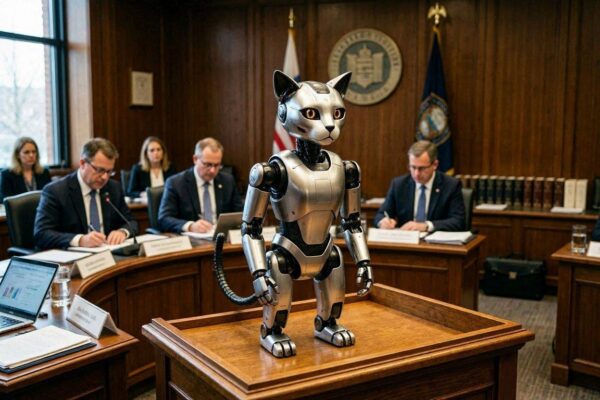

In a world drowning in corporate jargon, one plucky little site just dropped the perfect mirror: a satirical announcement from 7312.us declaring the launch of L.A.R.G.E. — the Lazy Automated Report Generator Environment. The press release (dated today, March 18, 2026) gleefully promises an AI that “writes the reports nobody asked for,” complete with audacity sliders, buzzword toggles, and the ability to slap a cat photo into a financial forecast. Head over to https://7312.us/large and you’ll find the actual app: a dead-simple form where you feed it a topic, recipients, and keywords, then watch Claude (via Anthropic’s API) spit out a perfectly formatted, utterly meaningless masterpiece in seconds. The disclaimers are longer than most actual reports, screaming “this is satire, do not use this to run your company, we’re all adults here.”
It’s hilarious. It’s also the best unintentional case study I’ve seen on exactly how AI is transforming the IT industry — not by replacing humans with robot overlords, but by exposing the absurd inefficiencies we’ve tolerated for decades and then automating them away.
The Satire That Hits Too Close to Home
L.A.R.G.E. doesn’t invent the problem; it weaponizes it. Corporate IT has always been report-heavy: status decks, ROI analyses, compliance summaries, architecture reviews. Most of them exist because someone, somewhere, needs to “show alignment” or “drive synergy.” Before AI, creating them required actual humans to stare at spreadsheets, copy-paste slides, and sprinkle in phrases like “leveraging cross-functional paradigms.” Now? You type “Q2 cloud migration impact” and get a PDF that looks board-ready in under a minute.
The joke works because the output is so convincingly empty — exactly like thousands of real documents floating in enterprise SharePoint folders right now. But here’s the meaningful part: the same underlying technology that powers this prank is already reshaping how IT professionals actually work.
Where AI Is Quietly Rewriting the Rules
- Documentation and Reporting — The Low-Hanging Fruit Tools like L.A.R.G.E. are the comedic extreme, but serious cousins (GitHub Copilot Docs, Notion AI, internal LLMs) are already drafting runbooks, updating knowledge bases, and generating stakeholder summaries. IT teams that once spent 30% of their week writing status reports now spend minutes reviewing AI drafts. The time saved? Redirected to actual engineering.
- Code Generation and Maintenance Modern IDEs with AI aren’t just autocomplete anymore. They suggest entire functions, refactor legacy code, and even explain decades-old COBOL. Enterprises using these tools report 30-50% faster feature delivery (real metrics from companies that aren’t 7312.us). The result isn’t fewer developers — it’s developers who ship more and debug less. The boring parts get automated; the creative architecture work gets supercharged.
- Infrastructure and Operations AI-powered AIOps platforms predict outages before they happen, auto-scale cloud resources, and write the incident post-mortems while the on-call engineer is still grabbing coffee. What used to require tribal knowledge and late-night war rooms is now pattern-matched by models trained on millions of telemetry events. The satire of “numbers that add up to whatever you need” flips into genuine predictive analytics that actually save money and downtime.
- Security and Compliance Threat detection models scan logs at machine speed, flagging anomalies humans would miss. AI-assisted policy engines translate regulations into enforceable IaC (infrastructure as code) rules. The same hallucination risk that makes L.A.R.G.E. funny becomes a controlled feature when models are grounded in verified data sources.
- The Human Shift Here’s the part the satire quietly celebrates: AI isn’t eliminating IT jobs — it’s eliminating drudgery. The industry is moving from “keep the lights on and file the paperwork” to “design the systems that actually move the business forward.” Roles evolve from report-writers to prompt-engineers, from ticket-closers to innovation leads. Yes, some repetitive tasks disappear. That’s the point of progress.
The Double-Edged Sword (and Why the Satire Matters)
Of course, the L.A.R.G.E. demo nails the risks too. Hallucinations dressed up in Helvetica can fool executives. Over-reliance on AI outputs without review is a liability waiting to happen. That’s why the real transformation isn’t the technology itself — it’s the cultural shift. Forward-thinking IT organizations are treating AI as a junior teammate that needs constant mentoring: great at volume, terrible at judgment. They build guardrails, validation loops, and human-in-the-loop processes. They use tools like the one at 7312.us not to deceive stakeholders, but to laugh at how easily deception used to happen.
The Bottom Line
The launch of a ridiculous AI report generator on a random Tuesday in 2026 isn’t just comedy. It’s proof that the barrier to entry for powerful AI has collapsed. What once required a data science team and six-figure budgets now runs on a home server and a free-tier API key. That democratization is flooding the IT industry with experimentation — some silly, some profound.
The reports nobody asked for are now being written in seconds. The real question for every IT leader is: what will you do with all the time you just got back?
Because while L.A.R.G.E. is busy generating nonsense, the rest of us can finally focus on building the future instead of documenting the present.
Try the app yourself at https://7312.us/large (and maybe don’t forward the output to your CFO). Then get back to work — the interesting kind. The AI revolution isn’t coming. It’s already here, and it’s got a sense of humor.