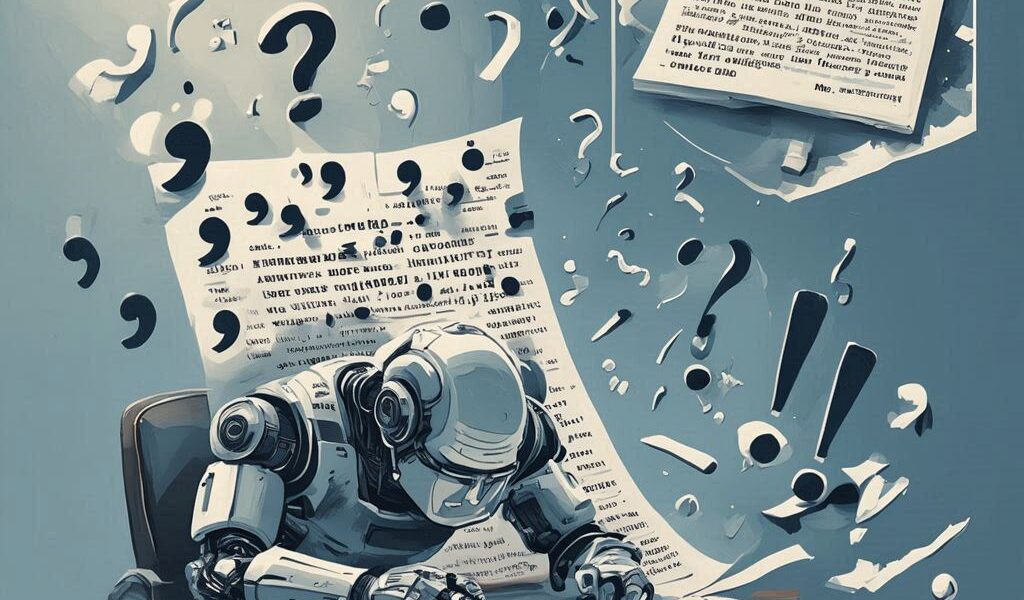
Generative AI has taken the world by storm with its ability to write text that feels natural, fluent, and eerily human-like. Yet, for all its mastery over words, punctuation remains a weak spot. If you’ve ever seen an AI-generated paragraph that wandered endlessly without a period or a question that forgot its question mark, you’re not alone. Understanding why this happens reveals not only the limitations of current language models but also the deeper challenges of teaching machines the subtleties of human writing conventions.
Understanding How AI Models Mismanage Punctuation
One of the core reasons AI systems fail at punctuation is the way they’re trained. Generative models like large language transformers learn to predict the next word—or token—in a sequence, but punctuation marks are not always treated with the same linguistic significance as words. In many training datasets, punctuation frequency and consistency vary widely depending on the source material. Social media text, chat logs, and informal writing often omit punctuation altogether, leading the model to treat ending marks as “optional” rather than essential.
Moreover, punctuation doesn’t carry much semantic weight compared to words, so models tend to deprioritize it during training. The statistical learning approach doesn’t understand that a period marks the end of an idea—it just sees it as another token that may or may not fit. Without a semantic anchor, punctuation becomes probabilistic rather than rule-based, resulting in missing or misplaced marks, especially in longer passages where coherence starts to drift.
Finally, punctuation usage in human language is stylistically diverse, adding another layer of confusion for generative systems. Some writers favor short, clipped sentences with many periods, while others use commas or dashes liberally. When an AI tries to generalize across millions of authors with differing habits, it ends up producing a neutralized, inconsistent punctuation style. This “average writing voice” often omits or mismanages punctuation simply because the training data never converged on a single standard.
The Hidden Linguistic Gaps Behind Missing Periods
Beneath the surface, punctuation problems also expose deeper limitations in how generative AI understands language structure. While AI can statistically associate words, it does not inherently grasp syntax, tone, or narrative cadence. Humans punctuate instinctively to reflect rhythm and emphasis, embedding emotional and logical cues in their sentence endings. An AI model, however, relies purely on token sequences—it doesn’t “feel” that a sentence has concluded, so it keeps generating words until a probabilistic pattern suggests otherwise.
This deficiency becomes even more apparent when AI handles multilingual or domain-specific text. Each language or field follows different punctuation logic—what counts as an acceptable comma in English might be incorrect in German or Spanish. If the model hasn’t distinctly learned those boundaries, it blurs linguistic conventions across contexts. This blending leads to awkward phrasing and inconsistent punctuation that betrays the underlying absence of true grammatical comprehension.
Another subtle factor is that punctuation rules often depend on meaning rather than syntax alone. For instance, the placement of a question mark reflects intent, not just sentence structure. Generative AI can mimic patterns, but it doesn’t infer intent; it predicts likelihoods. Without a genuine grasp of communicative purpose, the fine art of using periods, commas, or question marks precisely remains one of the most persistent frontiers for improvement in AI writing technology.
Punctuation may seem trivial next to the grand achievements of natural language generation, but it’s a revealing lens into what AI still lacks: contextual understanding, rhythm awareness, and purpose-driven communication. Each missing period is a symptom of a deeper truth—these models excel at pattern replication, not intentional expression. As researchers refine architectures and data preparation methods, the hope is that punctuation will evolve from a probabilistic afterthought into a faithfully reproduced element of style and logic. Until then, the humble period remains one of the clearest signs that human writing intuition still outpaces machine intelligence.