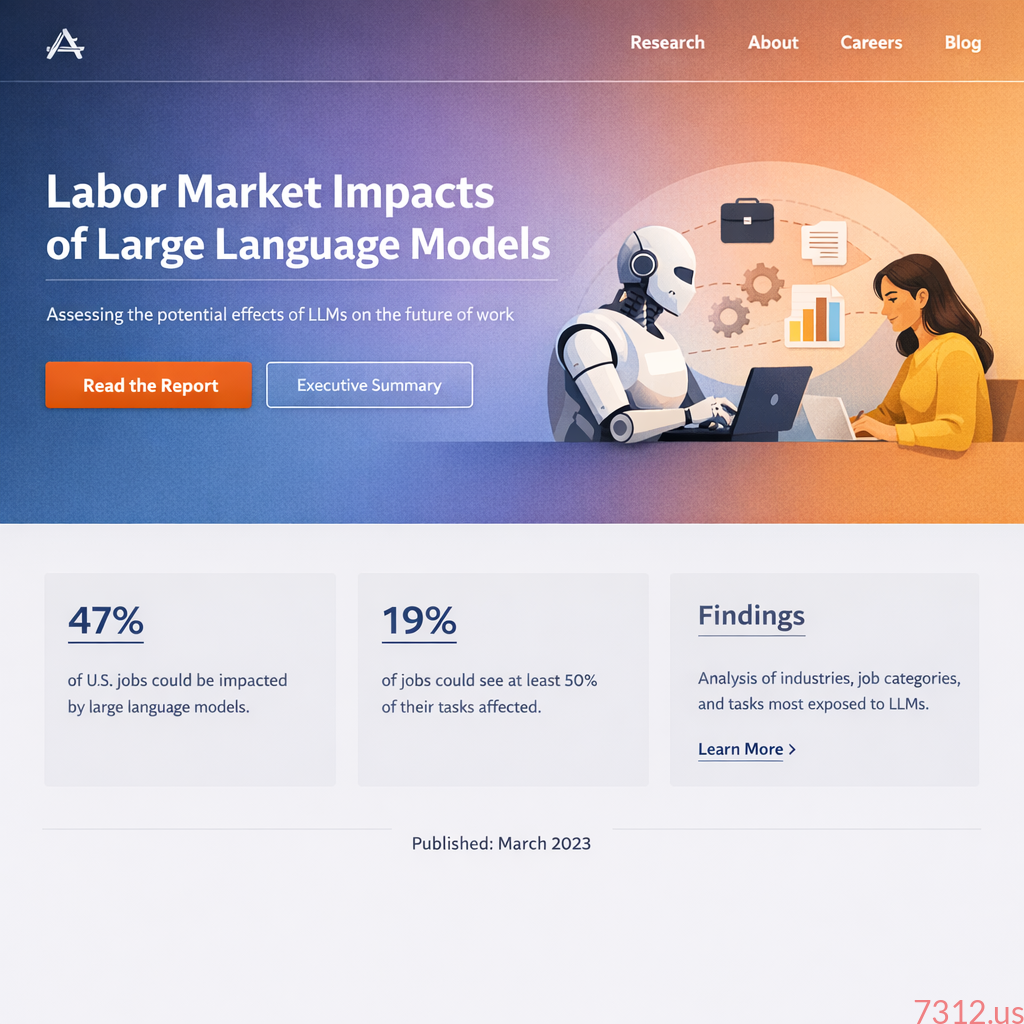
Anthropic’s labor market research adds a serious, evidence-based perspective to one of the biggest questions facing education and employment today: how AI is changing real work. Rather than treating AI as a vague future trend, the study looks at how people are already using advanced models across occupations and tasks. That matters for students deciding what to study, and for workers trying to stay valuable in changing industries. The core message is not simply that “AI will take jobs,” but that AI is being adopted unevenly, often helping with parts of jobs rather than replacing entire roles at once. For both students and workers, the practical challenge is to understand where AI complements human effort, where it automates routine tasks, and what skills remain durable.
Anthropic’s article on labor market impacts is especially useful because it focuses on task exposure. That framing is more realistic than broad claims about whole professions disappearing overnight. In most occupations, work consists of a mix of activities: some repetitive and codifiable, some social, some strategic, and some highly contextual. AI tends to move fastest into the first category. This aligns with broader research from institutions such as the International Labour Organization, McKinsey, Goldman Sachs, and the OECD, all of which suggest that generative AI is likely to reshape tasks within jobs before it fully eliminates jobs at scale. The result is a labor market where adaptation, not panic, is the most rational response.
For university students and current workers, the most important takeaway is that career planning now requires “AI literacy” alongside domain knowledge. That does not mean everyone must become a machine learning engineer. It means understanding what AI systems can do well, where they fail, and how to work with them responsibly. People who combine technical familiarity with judgment, communication, and subject-matter depth are likely to be in a stronger position than those who rely only on routine knowledge work. The students and workers who benefit most from this transition will be the ones who learn to supervise, integrate, verify, and improve AI-supported workflows rather than compete directly with automation on easily replicable tasks.
What Anthropic’s Labor Study Means for Students
Anthropic’s labor study suggests that students should stop thinking about majors and careers in overly static terms. A degree is still important, but its value increasingly depends on whether it leads to skills that can be applied in AI-rich workplaces. Students in fields with heavy exposure to writing, summarization, coding, analysis, and documentation should pay attention: these are exactly the types of tasks AI can often assist with or partially automate. That does not make such fields irrelevant. Instead, it means students in business, law, communications, computer science, marketing, economics, and similar disciplines need to be better than AI at framing problems, checking outputs, understanding context, and making decisions under uncertainty.
One major implication is that students should optimize for a combination of technical fluency and human differentiation. Anthropic’s findings point toward strong AI use in knowledge work, especially where tasks are digital and language-based. Additional evidence supports this. Studies by the OECD and World Economic Forum have consistently found that analytical thinking, problem solving, adaptability, and interpersonal skills are rising in importance. Meanwhile, research on generative AI in workplace productivity, including work by economists such as Erik Brynjolfsson and collaborators, shows that AI can raise performance, especially for less experienced workers, but only when tasks and workflows are structured enough for the tool to help. Students should therefore develop skills that let them use AI effectively while also building capacities AI does not easily replicate, such as negotiation, ethical judgment, teamwork, client trust, and original research design.
This means career preparation in university should become much more intentional. Students should build portfolios, not just transcripts. A student in journalism should show reporting, source verification, and interview work, not only polished prose. A computer science student should demonstrate the ability to debug AI-generated code, design systems, and explain tradeoffs. A law student should practice drafting with AI assistance while learning where hallucinations and false citations create risk. A biology or engineering student should know how AI can accelerate literature review or documentation, but also where domain expertise is indispensable. Internships, lab work, capstone projects, and evidence of responsible AI use will increasingly matter because employers will want proof that graduates can work with these tools in realistic settings.
Practical Career Advice for Current Workers
For people already in the workforce, Anthropic’s study is best read as a warning against complacency and also against fatalism. The warning is that many white-collar workers are exposed to AI-driven change sooner than they expected, especially in roles built around drafting, routine analysis, customer communication, coding support, scheduling, and reporting. The argument against fatalism is that exposure is not the same as replacement. In many settings, employers are using AI to reduce time spent on routine work while expecting humans to take on more review, coordination, escalation, and relationship management. Workers who understand this shift can reposition themselves before they are forced to react under pressure.
A practical first step is to audit your job by task. Write down what you do each week and separate it into categories: routine writing, research, spreadsheet work, client interaction, judgment calls, technical execution, and process management. Then ask which of these tasks AI can already accelerate, which require human review, and which depend heavily on trust, accountability, or physical presence. This exercise often reveals where a worker is vulnerable and where they remain valuable. Evidence from labor economists and consulting studies suggests that jobs are more resilient when they combine multiple kinds of work, especially when they involve social interaction, domain-specific judgment, compliance responsibility, and exceptions handling. If your role is highly repetitive and screen-based, the priority should be upskilling quickly. If your role already includes leadership, stakeholder management, or specialized expertise, the priority should be learning to use AI to raise productivity and expand scope.
Workers should also think in terms of “moving up the value chain.” If AI can generate a first draft, your value should come from defining the brief, improving quality, catching errors, aligning outputs with business goals, and communicating decisions clearly. If AI can write basic code, your value should come from architecture, testing, security, product understanding, and cross-functional collaboration. If AI can summarize documents, your value should come from deciding what matters and what action should follow. Additional evidence from sectors such as customer support and software development shows that AI often benefits workers who adapt their role rather than defend every old task. The strongest recommendation for current workers is simple: do not wait for your employer to design your transition. Learn the tools, document measurable gains, pursue certifications or training where useful, and make yourself the person who can bridge automation with reliable business results.
Anthropic’s labor study reinforces a difficult but useful truth: the labor market is not splitting neatly into “safe” and “unsafe” jobs. Instead, work is being reorganized at the task level, and that creates both risk and opportunity. For students, the right response is to pursue serious subject mastery while building AI literacy, practical experience, and unmistakably human strengths. For current workers, the best response is to identify automatable parts of their role, strengthen judgment-intensive and relationship-centered contributions, and learn how to supervise AI rather than compete with it directly.
The broader evidence points in the same direction. Generative AI is likely to increase productivity in many occupations, but productivity gains do not automatically translate into equal gains for every worker. Institutions, employers, universities, and individuals all need to adapt. Students should demand curricula that reflect the new reality of work. Workers should seek training before displacement forces a crisis. In both cases, the people most likely to succeed will be those who treat AI neither as magic nor as doom, but as a powerful tool that rewards preparation, realism, and continuous learning.