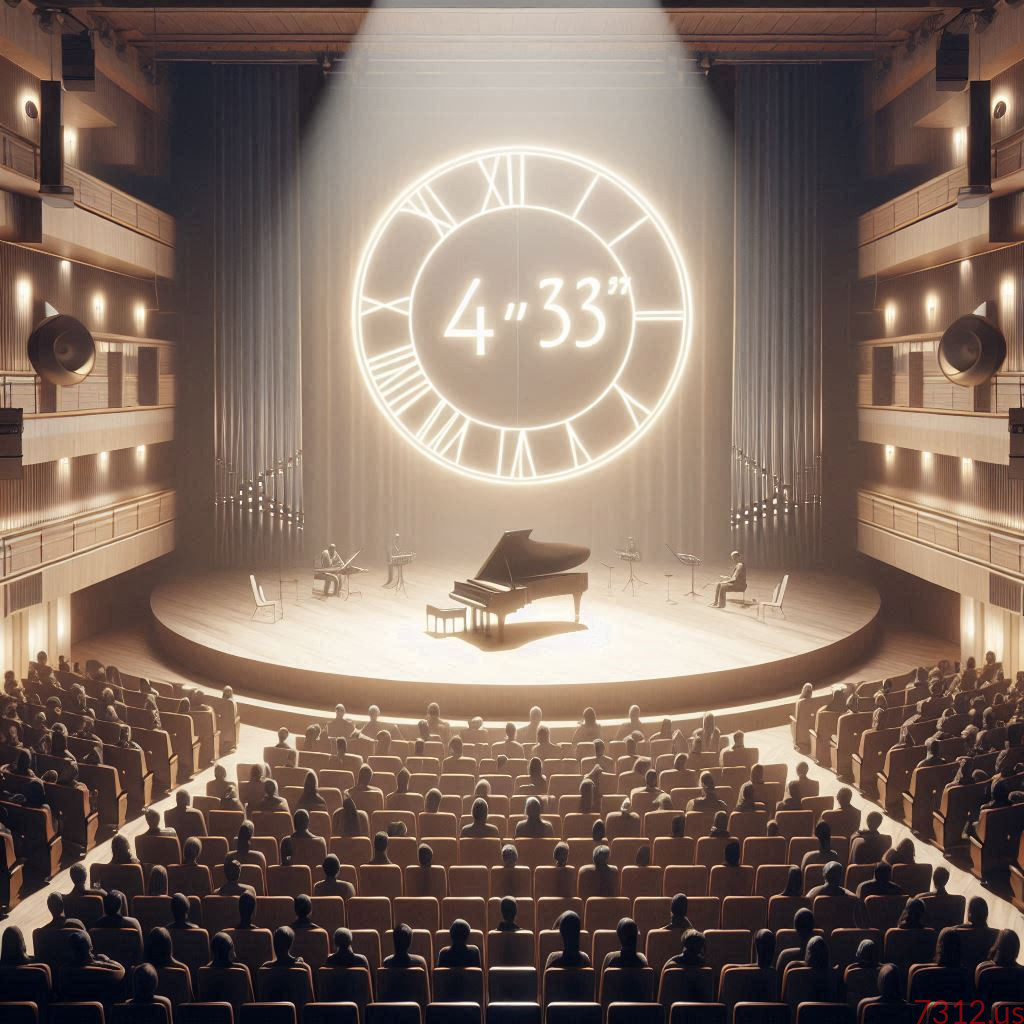
To critique John Cage’s 4′33″ is to engage with perhaps the most famous “prank” that isn’t actually a prank. Since its 1952 premiere, it has served as the ultimate Rorschach test for music lovers: is it a profound philosophical awakening or the emperor’s new clothes set to a stopwatch?
Regardless of where you land, it remains the most disruptive piece of the 20th century.
The Concept: Sound vs. Intention
The brilliance (or frustration) of 4′33″ lies in its subversion of the contract between performer and audience. Usually, we pay for intentional sound; Cage provides intentional listening.
- The Framework: The piece is divided into three movements. The performer (famously David Tudor at the premiere) signals the start and end by opening and closing the piano lid.
- The Content: The “music” is everything else—the hum of the air conditioning, the rustle of programs, the distant cough, or the uncomfortable shift of a neighbor in their seat.
The Critique: Three Perspectives
1. The Philosophical Triumph
From a Zen perspective—which heavily influenced Cage—the piece is a masterpiece of presence. It argues that “silence” does not exist. By removing the composer’s ego and the performer’s virtuosity, Cage forces the listener to find beauty in the chaotic, unintended sounds of reality. It democratizes sound; a car horn becomes as valid as a cello.
2. The Artistic Dead End
The most common criticism is that 4′33″ is a “one-trick pony.” Once the point is made—that ambient noise is interesting—the piece loses its utility. Unlike a Beethoven symphony, which yields new secrets upon the 100th listen, 4′33″ relies heavily on the shock of the initial experience. Critics argue it belongs more in a gallery of conceptual art than in a concert hall.
3. The “Gimmick” Accusation
There is a valid argument that 4′33″ is an exercise in academic elitism. It requires a specific, reverent setting to “work.” If you sit in silence at a bus stop, it’s just waiting; if you do it in Carnegie Hall, it’s “art.” This reliance on the institution of the concert hall can make the piece feel more like a lecture on aesthetics than a genuine musical experience.
The Legacy: Why It Still Matters
Cage didn’t write 4′33″ because he was lazy; he was a master of complex, avant-garde composition. He wrote it to break the “tyranny” of the composer.
“There is no such thing as an empty space or an empty time. There is always something to see, something to hear. In fact, try as we may to make a silence, we cannot.” — John Cage
Today, the piece lives on as a cultural meme, but its influence is everywhere—from the “ambient” music of Brian Eno to the way we value “found sound” in modern production. It taught us that the world is loud, even when we aren’t making a noise.