
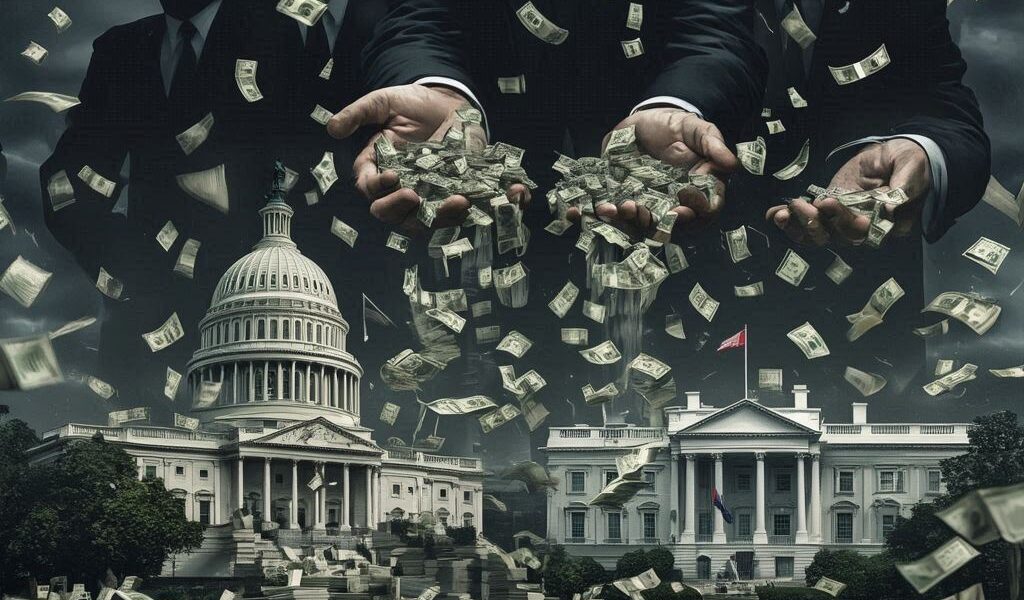
This article was written by AI. See “about“.
The following prompt was used: “Identify the top 20 companies making political contributions in last 2 years. Write a blog article trying to determine their motives.”
The 2024 general election was the most expensive in history, and the 2026 midterm cycle is already pacing to shatter those records. As of March 2026, the flow of political capital has shifted from traditional corporate PACs to “mega-donors” and industry-specific war chests that look more like investment funds than simple campaign contributions.
Here are the top 20 companies (and the corporate interests they represent) that have dominated the political financial landscape over the last two years.
The Top 20 Corporate Political Spenders (2024–2026)
Based on recent FEC filings and OpenSecrets data for the 2024 and 2026 cycles, these entities have deployed the most capital through PACs, super PACs, and direct corporate infusions:
| Rank | Company / Entity | Primary Interest Area |
| 1 | America PAC (Tesla/SpaceX/X) | Tech Deregulation & Government Efficiency |
| 2 | Las Vegas Sands (Adelson Family) | Gaming, Trade & Foreign Policy |
| 3 | Citadel (Ken Griffin) | Finance & Tax Policy |
| 4 | Coinbase | Cryptocurrency Regulation (CLARITY Act) |
| 5 | Ripple Labs | Blockchain Legal Frameworks |
| 6 | Andreessen Horowitz (a16z) | Venture Capital & AI Policy |
| 7 | Blackstone Group | Real Estate & Private Equity |
| 8 | Honeywell International | Manufacturing & Aerospace |
| 9 | Lockheed Martin | Defense & Federal Contracting |
| 10 | Comcast / NBCUniversal | Telecom & Media Regulation |
| 11 | Home Depot | Retail & Labor Policy |
| 12 | AT&T | Connectivity & Infrastructure |
| 13 | Northrop Grumman | National Security & Weapons Systems |
| 14 | Boeing | Aviation & Defense Export |
| 15 | Alphabet (Google) | Data Privacy & Antitrust |
| 16 | Amazon | Logistics & Cloud Computing |
| 17 | Meta (Facebook) | Social Media & Content Liability |
| 18 | L3Harris Technologies | Tactical Communications |
| 19 | Charter Communications | Broadband Monopolies |
| 20 | United Parcel Service (UPS) | Logistics & Postal Reform |
The Motive: Why Are They Spending?
If you follow the money, you’ll find that corporate motives have evolved from “buying access” to “writing the rules.” In 2025 and 2026, we’ve seen three distinct strategies emerge.
1. The “Existential Survival” Play (Crypto & Tech)
For Coinbase, Ripple, and a16z, political spending is a line item for survival. By pouring hundreds of millions into the Fairshake PAC and its affiliates, these companies are effectively lobbying for the CLARITY Act. Their motive is simple: replace the “regulation by enforcement” era with a clear, industry-friendly legal framework. If they don’t win in Washington, their business model faces extinction in the U.S. market.
2. The “Efficiency” Overhaul (Tesla & SpaceX)
Elon Musk’s America PAC represents a new breed of corporate spending. Unlike traditional PACs that hedge their bets by giving to both sides, this spending was laser-focused on a total executive overhaul. With the creation of the Department of Government Efficiency (DOGE) in 2025, the motive appears to be the removal of regulatory “friction” for SpaceX’s Mars missions and Tesla’s self-driving ambitions. It’s an investment in a world where the regulator and the regulated are on the same team.
3. The “Steady State” Protection (Defense & Telecom)
Names like Lockheed Martin, Boeing, and AT&T represent the old guard. Their motive is predictability. These companies rely on multi-decade government contracts and federal subsidies. Their contributions are “relationship insurance”—ensuring that no matter which party holds the gavel in 2026, the checks for F-35s and broadband expansion keep clearing.
4. The “Dark Money” Shield (Phizer, Altria, Nationwide)
Recent investigations into groups like Freedom Vote Inc. have revealed that companies in highly litigious or sensitive industries—like Pfizer (Pharma) and Altria (Tobacco)—often prefer “dark money” channels. Their motive is to influence policy regarding liability and consumer protection without attracting the public backlash or “cancel culture” that often follows overt political alignment.
Is This a “Business Strategy” or “Bribery”?
From a corporate perspective, these contributions are rarely about ideology; they are a capital expenditure with a calculated ROI. Whether it’s a tax break on carried interest for Blackstone or a favorable AI safety bill for Alphabet, the goal is to lower the cost of doing business.
As we head deeper into the 2026 midterms, the question isn’t whether corporations will keep spending, but rather which industry will be the next to decide that buying the law is cheaper than following it.



One thought on “Top 20 Corporate Political Spenders: Shaping the 2026 Midterm Elections and Their Motives”