
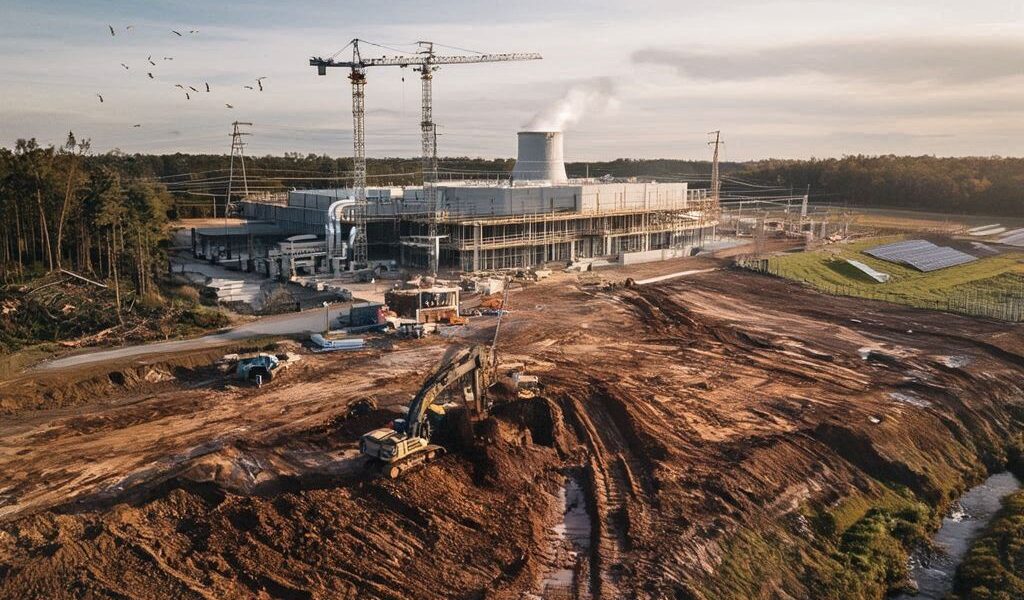
Constructing and operating a large data center has multifaceted environmental consequences, spanning energy consumption, greenhouse gas emissions, water use, land footprint, and local community effects, particularly as demand for AI, cloud computing, and streaming continues to grow. Based on comprehensive studies and empirical research as of 2025–2026, the impacts can be categorized as follows:
1. Electricity Consumption and Carbon Footprint
- Large data centers operate 24/7, requiring immense continuous power for servers, storage, networking, and cooling systems.
- U.S. data centers consumed roughly 180 terawatt-hours (TWh) per year in 2025 (~4% of U.S. electricity) and are projected to rise further; AI-powered centers could use 5 million gallons of water per day for cooling, equivalent to a small town’s daily electricity and water needs.
- Greenhouse gas emissions: Even with renewable energy purchases, most data centers draw from fossil-fueled grids. U.S. centers produced over 100 million metric tons of CO₂ annually, with full AI infrastructure potentially adding 24–44 million metric tons of CO₂ per year (equivalent to 5–10 million cars).
- Backup diesel generators emit particulates (PM2.5), nitrogen oxides (NOx), and sulfur oxides (SO₂), contributing to local air pollution and public health concerns.
2. Water Use and Cooling Impact
- Evaporative cooling and other water-intensive systems consume millions of liters daily, exacerbating water scarcity in drought-prone areas like Arizona, Nevada, and the Colorado River Basin.
- Heat waste can create local micro-climates, raising ambient temperatures. Some regions reuse this heat (e.g., district heating), but this is not yet widespread.
3. Land Footprint and Local Ecosystem Impacts
- Hyperscale data centers span hundreds to over 1,000 acres, displacing agricultural land, forests, and habitats, and potentially disrupting local wildlife.
- Construction and operation generate noise and light pollution, and can interfere with species’ behaviors (e.g., birds, cougars, mule deer) due to sensory disturbance.
4. E-Waste and Lifecycle Issues
- Rapid hardware upgrades (3–5 year cycles) produce large volumes of e-waste, including hazardous metals (lead, mercury, cadmium) from processors and circuit boards.
- Improper disposal or export of e-waste to developing countries can exacerbate environmental and human health risks.
5. Community and Economic Considerations
- Increased electricity demand can lead to higher utility bills, infrastructure strain, and reliance on fossil-fuel power plants.
- Though construction provides temporary employment, large data centers typically employ fewer than 150 permanent workers, raising questions about long-term local benefits.
- Marginalized communities are disproportionately affected where data centers cluster in socially vulnerable areas.
6. Mitigation and Sustainable Practices
- Energy Efficiency: Improved Power Usage Effectiveness (PUE), server virtualization, chip specialization, and AI-driven load management can reduce energy use per computation.
- Renewable Energy: Solar, wind, hydro, or nuclear integration; long-term contracts and on-site generation help offset emissions but may not fully capture real-time fossil fuel usage.
- Water Conservation: Liquid immersion cooling, recycled wastewater, and reduced evaporative cooling can lower consumption by 50–86% depending on siting.
- Heat and Resource Recycling: Waste heat recovery for local heating, recycling electronic components, and sustainable building materials reduce environmental footprint.
- Siting Decisions: Placing data centers in low-water-stress regions with clean energy grids can drastically reduce both carbon and water impacts.
- Regulatory Compliance: Noise, emissions, and e-waste regulations help minimize local human health and ecological risks.
7. Projected Impacts
- By 2030, global electricity use for data centers may double to 945 TWh, and greenhouse gas emissions could increase unless mitigated.
- Strategic operational and siting choices could reduce carbon emissions by ~73% and water use by ~86% relative to worst-case scenarios.
Conclusion
Large data centers profoundly affect the environment and communities through energy-intensive operations, significant water use, emissions, land transformation, sensory pollution, and e-waste generation. While measures like renewable energy, cooling optimization, and smart siting can mitigate some impacts, rapid AI expansion and hyperscale infrastructure amplify these pressures. Effective policy, community engagement, and sustainable technology deployment are critical to reducing the long-term environmental footprint of new data center construction.
References
- MIT MCSC Impact Fellowship Research
- U.S. Data Center Facts & Figures, Climate Challenge 2025
- World Resources Institute, U.S. Data Center Impacts
- Cornell AI Data Center Environmental Study, Nature Sustainability 2025
- STAX Engineering – Data Center Emissions Mitigation
Source(s):
1. https://impactclimate.mit.edu/2025/03/20/investigating-the-ecological-impacts-of-data-centers/
2. https://www.climatechallange.com/environmental-impact-of-u-s-data-centers-2025-facts-and-figures/
4. https://www.wri.org/insights/us-data-center-growth-impacts
8. https://news.cornell.edu/stories/2025/11/roadmap-shows-environmental-impact-ai-data-center-boom
10. https://www.staxengineering.com/stax-hub/the-environmental-impact-of-data-centers/