
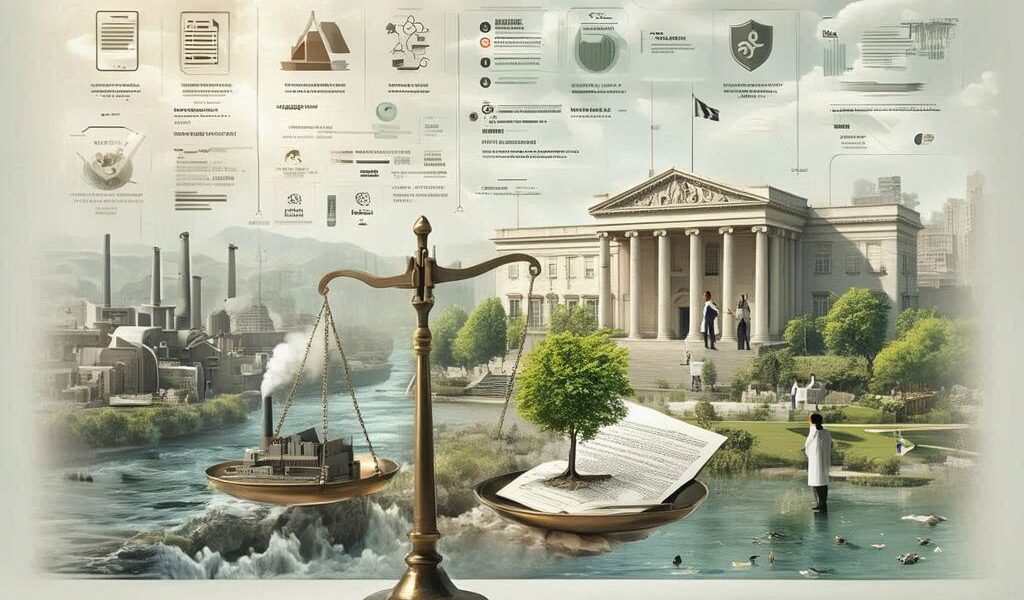
AI wrote this blog entry in response to the prompt “Write a detailed and nuanced article about whether environmental regulations do good or cause harm in the US. Provide specific examples. Provide a list of references. Come up with relevant recommendations.“
Environmental regulation in the United States has long been a source of political, economic, and philosophical debate. Supporters argue that regulations protect public health, ecosystems, and long-term economic productivity. Critics counter that they impose costly burdens, distort markets, and sometimes fail to deliver proportional benefits.
The truth, as is often the case in complex policy domains, lies somewhere in between.
I. The Case That Environmental Regulations Do Good
1. Strong Evidence of Net Social Benefits
One of the most studied environmental laws in U.S. history—the Clean Air Act—provides a benchmark for evaluating regulatory effectiveness.
- A comprehensive U.S. EPA analysis found that benefits of the Clean Air Act exceed costs by large margins, including ratios as high as 30:1 or more (US EPA)
- These benefits include:
- Hundreds of thousands of avoided premature deaths
- Millions of avoided illnesses
- Increased worker productivity and reduced healthcare costs (US EPA)
Similarly, earlier and later EPA studies consistently conclude that public health and environmental benefits outweigh compliance costs (US EPA).
Concrete Example: Air Pollution Reduction
- Cleaner air regulations have:
- Prevented millions of lost workdays
- Reduced hospitalizations and chronic disease burdens (US EPA)
These are not abstract gains—they translate into economic productivity, longer lifespans, and lower healthcare spending.
2. Public Health Gains Are Enormous
Environmental regulation often acts as preventive medicine at a societal scale.
Example: Fine Particulate (Soot) Regulations
- New EPA soot standards are expected to:
- Prevent thousands of premature deaths annually
- Deliver tens of billions of dollars in health benefits (The Guardian)
Example: Lead Regulation in Drinking Water
- Strengthening lead pipe rules is projected to yield:
- $8+ billion annually in health benefits
- Benefit-cost ratios as high as 35:1 (TIME)
These examples highlight a key point: many environmental harms are invisible but extremely costly when unregulated.
3. Economic Growth and Regulation Can Coexist
A common criticism is that regulation harms economic growth. However, evidence suggests the relationship is more complex.
- EPA economic research finds “measurable but not severe” impacts on overall economic growth (US EPA)
- Cleaner environments can:
- Increase labor productivity
- Reduce absenteeism
- Stimulate new industries (e.g., clean energy, environmental technology)
Example: Clean Power Plan (Proposed)
- Estimated benefits:
- Up to $45 billion annually
- Lower household energy costs
- Job creation in renewable energy (Wikipedia)
This reflects a broader trend: regulation can shift—not necessarily shrink—economic activity.
4. Addressing Environmental Inequality
Environmental harms are not evenly distributed.
- Freight-related pollution disproportionately affects minority communities and generates tens of billions in health damages annually (arXiv)
Regulations targeting emissions:
- Reduce inequality
- Improve outcomes in historically overburdened communities
II. The Case That Environmental Regulations Cause Harm
Despite clear benefits, there are legitimate criticisms.
1. High Compliance Costs and Economic Distortion
Environmental rules often impose significant upfront costs on businesses.
- Some analyses find that many climate regulations cost more than their direct climate benefits (arXiv)
- In certain sectors (e.g., transportation), up to 82% of regulations exceed the estimated social cost of carbon (arXiv)
Implication:
- Regulations may be economically inefficient
- Costs can fall heavily on:
- Small businesses
- Energy-intensive industries
- Consumers (via higher prices)
2. Uneven Distribution of Costs
Even when total benefits exceed costs, who pays and who benefits matters.
- Workers in fossil fuel industries may lose jobs
- Regions dependent on heavy industry can suffer economic decline
- Rural and low-income households may face higher energy costs
This creates political backlash and regional inequality.
3. Regulatory Uncertainty and Policy Instability
Frequent policy reversals can create instability.
Example: Climate Policy Rollbacks (2026)
- Revocation of greenhouse gas regulatory authority aims to:
- Reduce costs for industry
- Save up to $1.3 trillion (claimed by proponents) (Reuters)
However:
- Businesses face uncertainty about future rules
- Investment decisions become riskier
Even critics of regulation often prefer consistent regulation over regulatory volatility.
4. Inefficiency and Misaligned Incentives
Some regulations are poorly designed:
- Benefits often depend heavily on “co-benefits” (e.g., health gains) rather than core environmental goals (arXiv)
- This raises concerns that:
- Policies may not target problems efficiently
- Alternative approaches (e.g., carbon pricing) might be more effective
III. The Core Trade-Off: Efficiency vs. Protection
At its core, the debate hinges on a fundamental trade-off:
| Dimension | Regulation Helps | Regulation Hurts |
|---|---|---|
| Public Health | Reduces disease, mortality | — |
| Economy (macro) | Net positive in many studies | Sectoral disruption |
| Innovation | Drives clean tech | Can stifle legacy industries |
| Equity | Protects vulnerable populations | Costs unevenly distributed |
| Efficiency | Internalizes externalities | Can be poorly targeted |
IV. Synthesis: What the Evidence Actually Suggests
A balanced reading of the evidence suggests:
- Many major environmental regulations produce net societal benefits
- Not all regulations are equally efficient
- Costs are real and often concentrated
- Policy design—not regulation itself—is the key variable
In other words:
👉 The question is not “regulation or no regulation,” but “which regulations, designed how?”
V. Policy Recommendations
1. Prioritize Cost-Effective Regulations
- Use rigorous cost-benefit analysis
- Eliminate or redesign rules where costs exceed benefits
2. Use Market-Based Mechanisms
- Carbon pricing or cap-and-trade systems
- Encourage innovation rather than mandate specific technologies
3. Address Distributional Impacts
- Provide transition assistance to affected workers
- Subsidize energy costs for vulnerable households
4. Increase Regulatory Stability
- Avoid frequent policy reversals
- Provide long-term signals to businesses
5. Improve Measurement and Transparency
- Better tracking of real-world costs and benefits
- Independent review of regulatory outcomes
6. Focus on High-Impact Areas
- Air pollution (clear health benefits)
- Lead and water safety
- Industrial emissions near dense populations
VI. Conclusion
Environmental regulations in the United States have delivered enormous public health and environmental gains, often with benefits that exceed their costs. However, they are not universally efficient, and their economic burdens can be significant and unevenly distributed.
The real challenge is not choosing between regulation and deregulation—but designing smarter, more targeted, and more equitable policies.
References
- U.S. Environmental Protection Agency. Benefits and Costs of the Clean Air Act (US EPA)
- U.S. Environmental Protection Agency. The Clean Air Act and the Economy (US EPA)
- U.S. Environmental Protection Agency. Impacts of Environmental Regulation on the U.S. Economy (US EPA)
- EPA Retrospective Cost Study (US EPA)
- Academic paper: Cost-effectiveness of climate regulations (arXiv)
- Academic paper: Environmental injustice in freight trucking emissions (arXiv)
- Clean Power Plan summary and projections (Wikipedia)
- Reuters (2026): Climate regulation rollback (Reuters)
- The Guardian (EPA soot rule) (The Guardian)
- Time (Lead pipe regulation benefits) (TIME)