
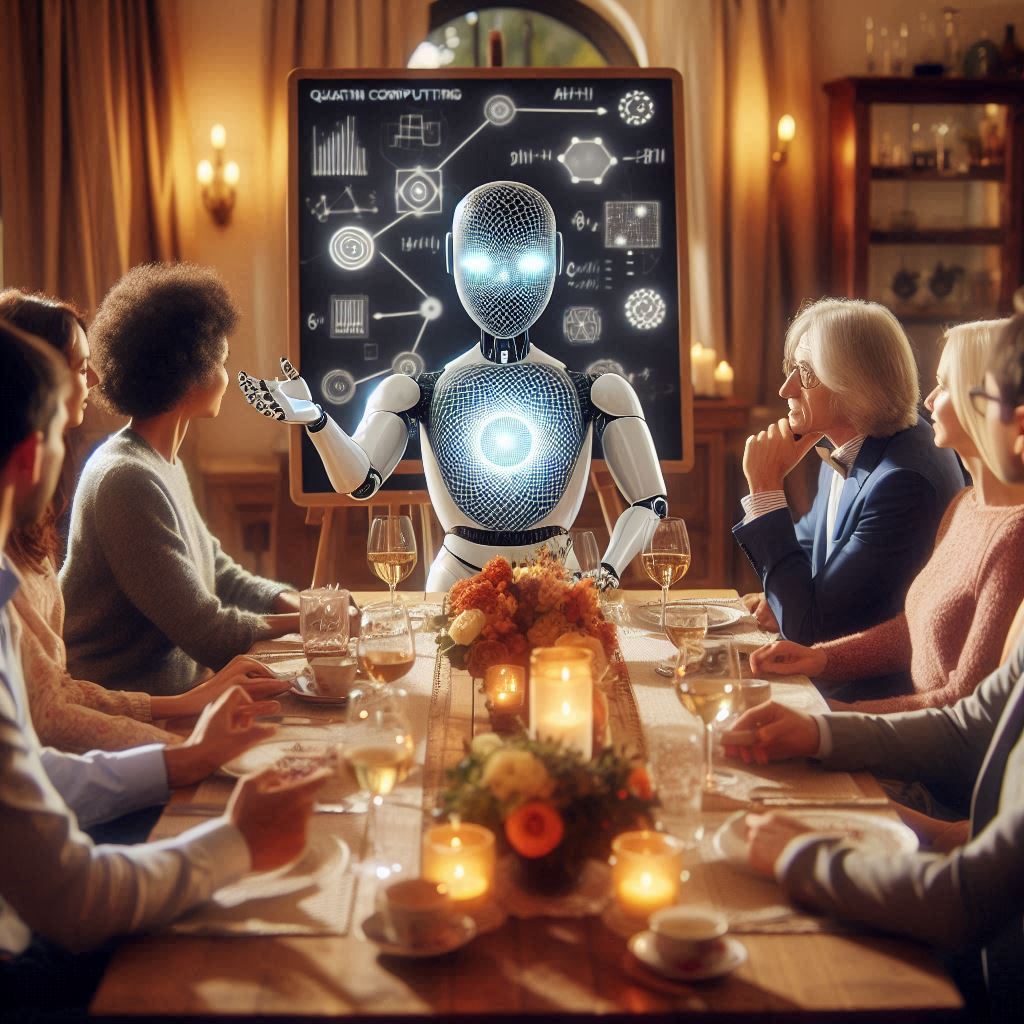
Laughing at Qubits – How Quantum Computing Meets AI
There are few things in life more confusing than trying to explain quantum computing at a dinner party—except maybe explaining it to an artificial intelligence. But humor has a funny way of softening the quantum blow. When we laugh at qubits, we’re really laughing at the universe for inventing a technology that makes logic feel like a surrealist painting. In this essay, we’ll explore how quantum computing and AI might form the strangest comedy duo of the century: one where the jokes are uncertain, and the punchlines exist in superposition until you look at them too closely.
When Schrödinger’s Cat Learns to Code in Python
Imagine Schrödinger’s cat—our favorite indecisive feline—deciding to pick up a new skill during its downtime in that box. Naturally, it chooses to learn Python. After all, if you’re both alive and not alive, recursion probably comes naturally. Quantum computing isn’t that different. Instead of bits that are either 0 or 1, qubits lounge in a shimmering haze of potential—both 0 and 1 at once, like our cat coding and napping simultaneously. This means that quantum computers can perform computations that would reduce a normal computer to tears faster than a syntax error in line 42.
When we apply this wonder to AI, our focus shifts from “what is the answer” to “what if there are many answers—superimposed, entangled, and waiting to collapse into brilliance.” AI powered by quantum computation could explore vast landscapes of possibility with mind-bending efficiency. For example, instead of slogging through one option after another in training a model, it can consider many outcomes at once, which is kind of like the universe’s version of multitasking—with extra sparkle and uncertainty.
And poor Schrödinger’s cat? It finds itself debugging its own existence in a Jupyter notebook. It writes code that both runs and doesn’t, trains neural networks that both converge and crash. Yet the beauty is in the absurdity: as quantum systems evolve, so too will our approach to machine intelligence—creations that might one day reason in probabilities rather than certainties. If AI is the clever apprentice, quantum computing is the mysterious wizard whispering in complex amplitudes rather than riddles.
Quantum Giggles: How Entanglement Teases Our AI
If computation had a sense of humor, entanglement would be its favorite prank. Two qubits connected through entanglement are so in sync that measuring one automatically reveals the state of the other, no matter how far apart they are—like two cosmic comedians finishing each other’s punchlines from opposite ends of the galaxy. For AI, this could mean a revolution in how distributed learning or multi-agent systems communicate. Imagine algorithms that share knowledge not by sending clunky packets of data, but by instantly knowing each other’s parameters, reducing the world’s lag one entangled giggle at a time.
Of course, it’s not all smooth quantum sailing. Entanglement is fragile, and decoherence lurks like a heckler at a physics comedy club. One stray photon or thermal wobble can throw the show into chaos. For AI models, this means the dream of seamless quantum training still wrestles with noisy hardware and uncertain measurements. But perhaps that’s the beauty of it—artificial intelligence learning to cope with imperfect, probabilistic information mirrors human adaptability itself. When an AI learns to laugh at its own uncertainty, maybe it’ll finally understand us.
And speaking of laughter, it’s hard not to chuckle at the absurdity of it all. Traditional computers crunch numbers as tidy accountants; quantum computers, meanwhile, host a wild masquerade ball of states, collapsing into results only when you peek inside. If entanglement is the setup and decoherence the punchline, then AI is the attentive audience, trying desperately to make sense of the joke. The intersection of these fields promises not only faster problem solving but a richer, more nuanced understanding of intelligence—perhaps one that recognizes that even the smartest systems benefit from a little constructive confusion.
As we peer into this quantum comedy club of the future, one thing becomes clear: the collaboration between quantum computing and AI isn’t just a technological evolution—it’s a philosophical one. It asks us to embrace uncertainty not as weakness but as wonder. AI has long mirrored our logic; soon, powered by qubits, it might mirror our creativity, our humor, and our glorious contradictions.
So as Schrödinger’s cat commits another quantum push to GitHub, we can grin at the paradox. Laughing at qubits isn’t mockery—it’s appreciation. It’s the recognition that in this brave new world of entangled intelligence, knowledge isn’t always black and white, 0 or 1, deterministic or random. Sometimes, it’s all of the above—and somehow, in that shimmering mess of probability, the future of AI might just learn to laugh along with us.
One Comment